
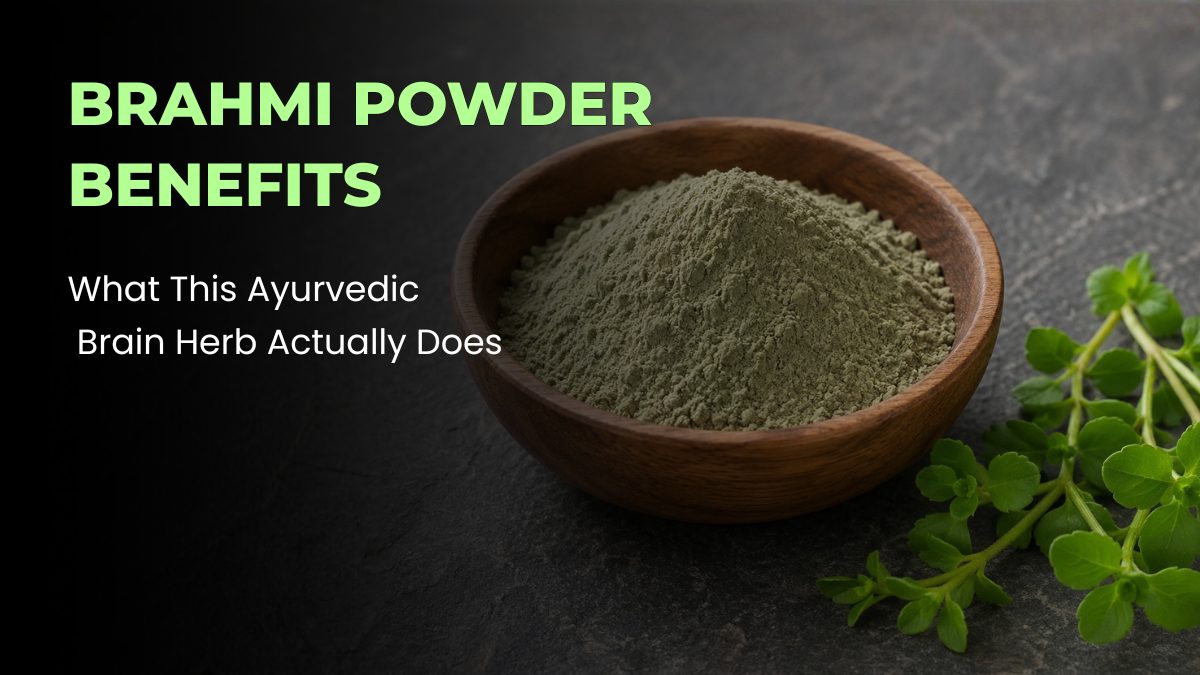
Brahmi is one of the few Ayurvedic herbs where the traditional claim — "it improves memory" — has actually been tested in Indian clinical trials with measurable outcomes. A randomised, double-blind, placebo-controlled trial conducted at King George Medical College, Lucknow, found that standardised Bacopa monnieri extract significantly improved retention of new information in adults over 12 weeks. A separate trial at Government Medical College, Nagpur, found statistically significant cognitive improvements in medical students after just 6 weeks. Most Ayurvedic memory claims are traditional and unverified. Brahmi is the exception — and understanding why it works is more useful than the claim alone.
Quick Answer: Brahmi — botanical name Bacopa monnieri — is a perennial herb native to India's wetlands, used in Ayurveda since 800 BC as a Medhya Rasayana (intellect enhancer). Its active compounds, called bacosides, repair damaged neurons, enhance synaptic communication, and reduce cortisol levels. Research supports its use for memory retention, reduced anxiety, and cognitive function — particularly for delayed recall and retention of new information. Effects build over 8–12 weeks of consistent daily use. It does not produce immediate results.
What Brahmi Actually Is — and Why It Is Not the Same as Gotu Kola
There is a persistent confusion in the Indian herbal market that is worth clearing up immediately. Two herbs are sold under the name "brahmi" — Bacopa monnieri and Centella asiatica (gotu kola, also called mandookaparni). Both are used in Ayurveda for cognitive support. They are different plants with different active compounds and different primary applications.
Bacopa monnieri — the subject of this post — is the herb most research refers to when studying brahmi's cognitive effects. It grows in marshy areas across India, particularly in the northeast and south. Its active compounds are bacosides — triterpenoid saponins unique to this plant. When you buy "brahmi powder" in India, you are most likely buying Bacopa monnieri, but it is worth checking the botanical name on the label to be certain.
Centella asiatica has its own legitimate benefits, primarily for wound healing, circulation, and skin health. It is not the same thing. If a product label says "brahmi" without specifying Bacopa monnieri, ask the vendor which plant it actually is.
What Bacosides Do in Your Brain — the Mechanism Behind the Memory Claim
Brahmi's cognitive effects are not vague or poorly understood. The mechanism is documented. Bacosides — the primary active compounds in Bacopa monnieri — work through three distinct pathways.
They repair damaged nerve cells. Bacosides have been shown to promote the regeneration of nerve cells in the hippocampus — the brain region most directly involved in memory formation and retention. They do this by increasing the synthesis of proteins involved in synaptic plasticity — the brain's ability to strengthen connections between neurons that are used repeatedly. This is the biological basis of learning and memory consolidation.
They increase acetylcholine availability. Acetylcholine is the primary neurotransmitter for memory and learning. Bacosides inhibit the enzyme (acetylcholinesterase) that breaks down acetylcholine, keeping it available in the synapse longer. This is the same mechanism used by some Alzheimer's medications — brahmi works through a similar but gentler pathway at dietary doses.
They reduce cortisol. Cortisol — the stress hormone — actively impairs memory formation and recall when chronically elevated. Bacopa monnieri has demonstrated adaptogenic properties in multiple studies, reducing cortisol levels and anxiety scores in subjects under stress. Lower cortisol means the hippocampus functions better. This is why brahmi's cognitive benefits are more pronounced in people under chronic stress — it is removing a specific obstacle to memory function, not just adding stimulation on top.
What the Indian Clinical Trials Actually Found
Two Indian RCTs are worth knowing specifically — not because they are the only studies, but because they are Indian populations, Indian institutions, and the most directly relevant to how brahmi is used here.
A randomised controlled trial at King George Medical College, Lucknow (Indian Journal of Psychiatry, 2010), studied 81 adults aged 55 and above with age-associated memory impairment. Subjects received 125mg of standardised Bacopa monnieri extract twice daily for 12 weeks. The trial found significant improvements in logical memory, paired associate learning, and mental control — specifically in the retention of newly acquired information. Critically, the rate of learning was unaffected — brahmi slowed the rate of forgetting, not speeding up initial acquisition. That distinction matters for how you understand the herb's practical use.
A six-week randomised double-blind trial at Government Medical College, Nagpur (Evidence-Based Complementary and Alternative Medicine, 2016), enrolled 60 medical students under high academic stress. Students receiving 150mg of standardised Bacopa extract twice daily showed statistically significant improvement in cognitive function tests compared to placebo. The study population — young, educated, high-stress individuals — is more representative of how most Indian urban professionals would actually use brahmi.
The honest limitation across most brahmi research: studies use standardised extracts with defined bacoside content — not raw powder. The bacoside concentration in brahmi powder varies significantly by plant quality, drying method, and processing. The clinical results apply most reliably to standardised extracts; the extrapolation to raw powder requires the assumption that your powder has consistent bacoside content, which is not guaranteed unless sourced from a quality-controlled supplier.
Brahmi for Anxiety — the Underreported Benefit
Most brahmi discussions focus on memory. The anxiety evidence is equally compelling and gets less attention.
Cortisol reduction is one mechanism. Brahmi also modulates the GABAergic system — the brain's primary inhibitory neurotransmitter pathway, the same one targeted by anti-anxiety medications. Unlike pharmaceutical GABAergic drugs, brahmi does not cause sedation or dependence at standard doses. It produces what researchers describe as a "calming cognitive enhancement" — reduced anxiety without reduced alertness.
This combination is particularly relevant for people whose cognitive performance is impaired by anxiety — students before exams, professionals under deadline pressure, people whose stress directly interferes with their ability to concentrate and retain information. For this group, brahmi addresses the root cause of the cognitive impairment rather than just stimulating mental activity on top of an anxious state.
How to Use Brahmi Powder — Dose, Timing, and the Patience Required
Brahmi is not a stimulant. It does not produce a noticeable effect within hours of taking it. This is the most common reason people abandon it — they take it for a week, notice nothing, and conclude it does not work. The clinical trials that show results used 6–12 weeks of consistent daily use. That timeline is not arbitrary — it reflects how long neuronal repair and synaptic remodelling take to produce measurable cognitive changes.
The traditional Ayurvedic dose for brahmi powder is 3–6g daily, typically split into two doses — morning and evening with warm milk or water. Warm milk is the traditional carrier because the fat content improves absorption of the fat-soluble bacosides. Warm water works. Cold water is less effective.
Some people add a small amount of honey to offset the slightly bitter taste of raw brahmi powder. This is a traditional preparation and there is no functional conflict. Avoid combining brahmi with sedative medications without medical advice — the combined GABAergic effect can amplify sedation.
For cognitive support specifically, morning use makes the most practical sense — the anxiety-reducing effect supports the day's mental work, and the memory consolidation effect operates over the subsequent hours. Evening use is more appropriate if the primary goal is sleep quality and stress reduction.
What to Check When Buying Brahmi Powder
Three checks that matter for brahmi powder quality.
Botanical name on the label: It should say Bacopa monnieri, not just "brahmi." If it says Centella asiatica — that is a different herb. If no botanical name is listed, ask.
Colour and smell: Genuine Bacopa monnieri powder is pale green to light grey-green. A very brown or dark powder may indicate over-drying or adulteration with other plant material. Fresh brahmi powder has a faintly bitter, slightly earthy smell — not musty or fermented. Musty smell means moisture damage during storage, which degrades bacosides.
Single ingredient: Pure brahmi powder should list one ingredient — Bacopa monnieri. Products that combine brahmi with ashwagandha, shankhpushpi, or other herbs are not necessarily inferior, but they are combination products — the brahmi content per serving is lower than a single-herb powder, and the attribution of any effects becomes less clear.
For certified organic brahmi powder with verified sourcing, PureStora carries Brahmi Powder 100g by Bionode Organics — single ingredient, Bacopa monnieri, verified before listing. Browse the full Health & Wellness range for other certified Ayurvedic herb powders.
Frequently Asked Questions
How long does brahmi powder take to work?
The clinical trials that showed significant cognitive improvement used 6–12 weeks of consistent daily use. Most people notice subtle changes in anxiety and stress levels within 2–3 weeks — the memory and retention benefits take longer because they depend on neuronal repair processes that are inherently slow. Expecting results within days is the most common mistake people make with brahmi. Consistency over weeks is the only approach that produces the outcomes the research shows.
Can brahmi powder be taken daily?
Yes — brahmi is considered safe for daily use at standard doses (3–6g of powder or 150–300mg of standardised extract) in healthy adults. It has a high therapeutic index, meaning the gap between an effective dose and a harmful dose is wide. The most commonly reported side effects are mild gastrointestinal — nausea or loose stools — usually from taking it on an empty stomach. Taking it with warm milk or after food resolves this for most people. Pregnant women and people on sedative medications should consult a doctor before daily use.
What is the difference between brahmi powder and brahmi extract?
Brahmi powder is the whole dried plant ground to a powder — it contains bacosides alongside all other plant compounds. Brahmi extract is concentrated and standardised to a specific bacoside percentage — the clinical trials typically use extracts standardised to 20–55% bacosides. Extract provides a more predictable dose of the active compound. Powder is more affordable, retains the full spectrum of plant compounds, and is the traditional form — but bacoside content varies by batch. For the specific memory outcomes measured in clinical trials, standardised extract is more reliable. For general Ayurvedic tonic use, powder is fine.
Does brahmi help with sleep?
Research suggests brahmi's cortisol-reducing and GABAergic effects support improved sleep quality — particularly for people whose poor sleep is driven by anxiety or an overactive mind rather than a primary sleep disorder. It is not a sedative and does not cause drowsiness during the day at standard doses. Evening use with warm milk is the traditional approach for sleep support. For a broader overview of Ayurvedic herbs and their evidence base, see our guide on Ayurvedic superfoods and what the research actually says.
Is brahmi safe for children?
Brahmi has been used in Ayurveda for children's cognitive development for centuries, and a recent Indian randomised trial specifically studied its effects on healthy school-age boys. At traditional doses it is generally considered safe for children. However, paediatric supplementation should always be discussed with a doctor — dosing for children differs from adults, and the standardised extract doses used in adult trials are not directly applicable to children.
Conclusion
Brahmi stands out in the Ayurvedic herb space because the primary claim — memory improvement — has been tested in Indian clinical trials with Indian populations and produced measurable results. The mechanism is understood: bacosides repair neurons, preserve acetylcholine, and reduce cortisol. The requirement is patience — 8 to 12 weeks of daily use, not a week's trial. And the quality variable is bacoside content, which depends on how the plant was grown, dried, and processed. Certified organic sourcing reduces but does not eliminate that variability. For verified brahmi powder with transparent sourcing, browse PureStora's Health & Wellness range.
Disclaimer: This article is for general informational purposes only and is not a substitute for medical, nutritional, or professional advice. Brahmi powder is not a treatment or cure for any neurological or psychiatric condition. Consult a qualified healthcare provider before use if you are on medication or managing a health condition.
