
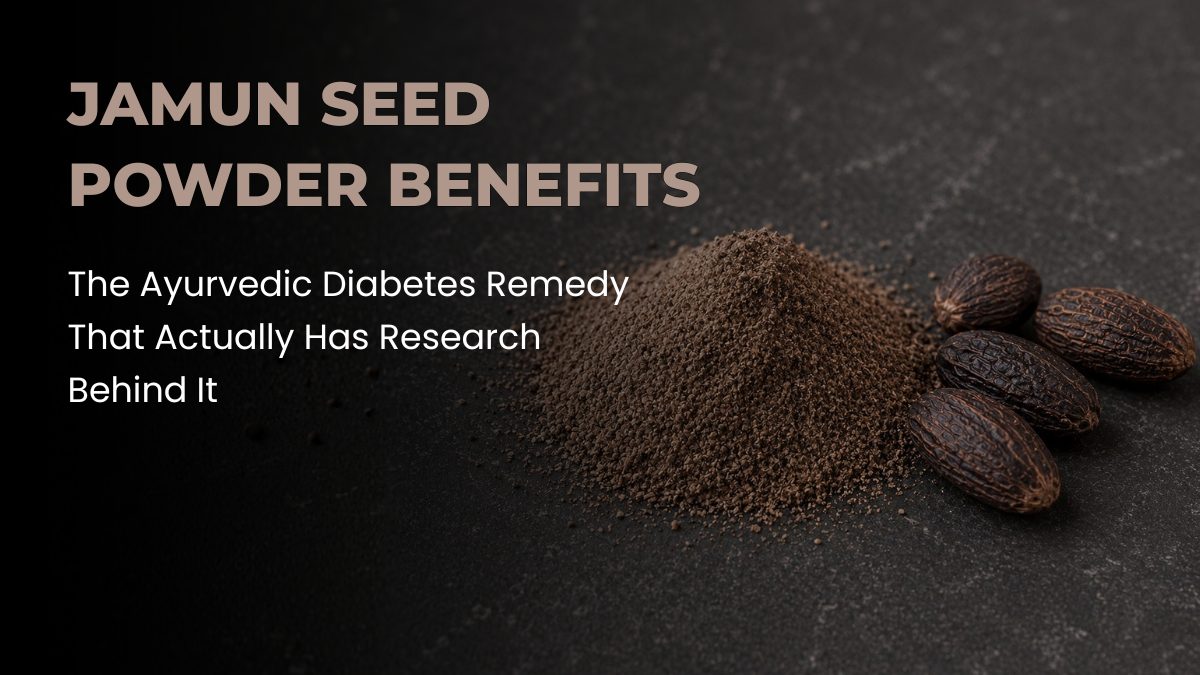
Every summer, Indians eat jamun — the dark purple berry that stains your tongue and fingers — and throw the seeds away. Those seeds are the part Ayurveda has been using to manage blood sugar for over a century. Jamun seed powder contains a compound called jamboline that directly inhibits the enzyme responsible for converting starch into glucose. That is not a folk claim. It is documented in the Ayurvedic Pharmacopoeia of India published by the Ministry of AYUSH, and it is the basis for AYUSH-82 — an antidiabetic Ayurvedic formulation developed by the Central Council for Research in Ayurvedic Sciences (CCRAS). The part of the jamun most Indians discard is the part with the most clinical backing.
Quick Answer: Jamun seed powder — called jambu churna or jambu beeja churna in Ayurveda — is made from the dried, powdered seeds of Syzygium cumini (Indian blackberry). It contains jamboline, ellagic acid, and alkaloids that research suggests inhibit starch-to-sugar conversion, stimulate insulin secretion, and reduce post-meal blood glucose. The typical Ayurvedic dose is 2–3g powder with warm water before meals. It is not a replacement for diabetes medication — it is a dietary adjunct with documented traditional use and supporting research, primarily relevant for blood sugar management in prediabetes and Type 2 diabetes.
What Jamun Seeds Actually Contain — and Why the Seeds Beat the Fruit
The jamun fruit gets attention for its anthocyanins — the dark purple pigments with antioxidant properties. The seeds are pharmacologically more interesting. Jamun seeds contain three compounds that work together on blood sugar in ways the fruit flesh does not.
Jamboline — a glycoside unique to Syzygium cumini — inhibits the diastatic conversion of starch into sugar. What this means practically: when you eat a carbohydrate-heavy meal, enzymes in your digestive tract break down starch into glucose. Jamboline slows this conversion, which reduces how quickly and how much glucose enters your bloodstream after eating. This is the same principle behind some diabetes medications — jamun seeds do it through a plant compound rather than a synthetic drug.
Ellagic acid — a polyphenol also found in pomegranates and amla — adds antioxidant and anti-inflammatory effects that reduce oxidative stress in pancreatic cells. Chronically elevated blood sugar damages beta cells, the insulin-producing cells in the pancreas. Ellagic acid research suggests it helps protect these cells from that damage.
Jambosine — an alkaloid — has been shown in studies to stimulate insulin secretion from the pancreas. Combined with jamboline's starch-conversion inhibition, the seeds work on blood sugar through two distinct mechanisms simultaneously. This is why Ayurvedic practitioners have combined jamun seeds with other antidiabetic herbs — each working through a different pathway — rather than using them as a standalone treatment.
What the Research Actually Shows — and Where It Is Honest About Limitations
The evidence for jamun seed powder is stronger than most people assume and weaker than its most enthusiastic proponents claim. That tension is worth being clear about.
The strongest evidence comes from animal studies and small human trials. A human study cited in a 2022 review of jamun's effects on metabolic syndrome (Molecules, MDPI) found that supplementation with jamun seed capsule powder at 4.5g per day in prediabetes patients significantly improved glucose levels and reduced total cholesterol from 266 to 216 mg/dL and LDL from 189 to 139 mg/dL. Those are clinically meaningful reductions, not marginal changes.
The Central Council for Research in Ayurvedic Sciences (CCRAS) — the apex body for Ayurvedic research under India's Ministry of AYUSH — included jamun as a key ingredient in AYUSH-82, its officially developed antidiabetic Ayurvedic formulation. That level of institutional validation from a government research body is a stronger signal than most herbal supplement claims have.
The honest limitation: most human trials are small, short-duration, and have not yet been replicated at the scale that would satisfy modern clinical evidence standards. Jamun seed powder is not a pharmaceutical-grade intervention with Phase III trial data. It is a traditional remedy with multiple supporting studies and strong mechanistic evidence — which is a meaningful category, as long as that is how it is understood.
Who Should Actually Consider Using It — and Who Should Not
Jamun seed powder makes the most practical sense for three groups of people.
People with prediabetes — fasting glucose between 100–125 mg/dL — who want a dietary adjunct alongside lifestyle changes. The research on prediabetes is more directly applicable than the Type 2 diabetes data, and this is where prevention-focused use has the most logical case.
People with Type 2 diabetes using it as a complement to their existing medication — not a replacement. The key word is complement. Jamun seed powder taken alongside metformin or other oral hypoglycemics does not conflict mechanistically. It works through a different pathway. But the combination requires monitoring because the combined glucose-lowering effect can be stronger than either alone.
People with a strong family history of diabetes who want dietary-level blood sugar support. Two to three grams of jamun seed powder before meals is a low-risk dietary practice with documented traditional backing and a plausible mechanism. At that dose it functions as a food, not a drug.
Who should not use it without medical supervision: Anyone on insulin — jamun's glucose-lowering effect can compound insulin and cause hypoglycaemia. Pregnant women — there is insufficient safety data on high-dose use during pregnancy. Anyone with hypoglycaemia already — the combination of multiple blood sugar lowering approaches without monitoring is a risk.
The Right Way to Use Jamun Seed Powder — Dose, Timing, and Form
The traditional Ayurvedic dose documented in classical texts and supported by research is 2–3g of jamun seed powder taken with warm water, before meals. This translates to approximately half a teaspoon, twice daily — before lunch and dinner are the most relevant meals given the carbohydrate load they typically carry in an Indian diet.
Timing before meals matters for the same reason it does with isabgol — the active compounds need to be present in the gut when carbohydrates arrive to slow their conversion and absorption. Taking jamun seed powder after a meal misses the functional window.
Warm water is the traditional medium and there is a practical reason: it helps the powder dissolve more fully before entering the stomach. Some people mix it into buttermilk (chaas) — which is a traditional pairing across Maharashtra and Karnataka — or stir it into a small amount of honey. Both work. Avoid cold water — it does not dissolve the powder as effectively.
Jambu churna — the traditional Ayurvedic preparation — is jamun seed powder, sometimes combined with other antidiabetic herbs like karela (bitter gourd) or methi (fenugreek). If you are using a combination product, read the ingredient list to understand what you are taking beyond the jamun seeds themselves.
What to Check Before Buying Jamun Seed Powder
The Indian market for jamun seed powder has quality variation that matters for efficacy. The seeds must be properly dried and processed — too much heat during processing degrades jamboline, which is the primary active compound. This is not something you can verify from the packaging, but two checks help filter for quality.
Ingredient list: Pure jamun seed powder should show one ingredient — Syzygium cumini seed. If the list includes fillers, starches, or unnamed "herbal extracts," the jamboline concentration is diluted and the product is less effective.
Colour: Genuine jamun seed powder is a pale beige to off-white colour. Seeds are naturally lighter inside — the dark purple pigment is in the fruit flesh, not the seed. A very dark brown or purple-tinged powder suggests the fruit flesh has been included with the seeds, which changes the nutritional profile and reduces the concentration of seed-specific compounds.
Certification: For jamun seed powder grown without synthetic pesticides, look for FSSAI Organic or India Organic (Jaivik Bharat) certification. At PureStora, every vendor is required to submit valid certification documentation before listing. PureStora carries Jamun Seed Powder 100g by Bionode Organics — single ingredient, verified before listing. Browse the full Health & Wellness range for other certified options.
Frequently Asked Questions
What is jamun seed powder good for?
Jamun seed powder is primarily documented for blood sugar management. The compound jamboline inhibits starch-to-sugar conversion; jambosine stimulates insulin secretion; ellagic acid reduces oxidative stress in pancreatic cells. Research also supports anti-inflammatory and digestive benefits. It is most relevant as a dietary adjunct for prediabetes and Type 2 diabetes management, used alongside appropriate medical care — not as a standalone treatment.
How much jamun seed powder should I take per day?
The traditional Ayurvedic dose and the amount used in most research is 2–3g daily — approximately half a teaspoon — taken in warm water before meals. Some studies used up to 4.5g daily. Start at the lower end and assess tolerance. Anyone on diabetes medication should monitor blood sugar more closely when starting, as the combined effect can be stronger than either alone. Consult a doctor if you are on insulin or oral hypoglycemics.
Is jamun seed powder safe for diabetics on medication?
It can be used alongside oral diabetes medication but requires monitoring. The glucose-lowering mechanisms of jamun seed powder and medications like metformin work through different pathways — they can complement each other, but the combined effect may lower blood sugar more than either does alone. Anyone on insulin specifically should not add jamun seed powder without medical supervision, as hypoglycaemia is a real risk. Always inform your doctor before adding any supplement to a diabetes management plan.
What does jamun seed powder taste like?
Slightly bitter and astringent — which is consistent with its tannin and alkaloid content. It is not unpleasant but it is not neutral either. Most people find it more palatable mixed into warm chaas (buttermilk) with a pinch of black salt, which balances the bitterness. Some mix it into warm water with a small amount of honey. The taste signals the active compounds are present — completely tasteless jamun seed powder is often an indicator of poor quality or heavy dilution.
Can jamun seed powder cure diabetes?
No — and any product or claim suggesting it can is misleading. Type 2 diabetes is a chronic metabolic condition that requires comprehensive management including diet, physical activity, and often medication. Jamun seed powder is a dietary adjunct with documented effects on blood glucose markers — it can support management, not replace it. The distinction matters practically and legally. For more on how Ayurvedic ingredients fit into a real dietary approach, see our guide on Ayurvedic superfoods and what the research actually says.
How is jamun seed powder different from isabgol for blood sugar?
They work through entirely different mechanisms. Isabgol (psyllium husk) reduces post-meal blood sugar by forming a gel that slows glucose absorption from all carbohydrates — it is a physical/mechanical effect. Jamun seed powder works through specific plant compounds (jamboline, jambosine) that inhibit the enzyme converting starch to sugar and stimulate insulin secretion — a biochemical effect. Both can be used together without conflict; they address different parts of the blood sugar response. For more on isabgol's effects and how to take it, see our post on isabgol benefits.
Conclusion
Jamun seed powder is not a trend. It is a documented Ayurvedic ingredient with a specific, understood mechanism — jamboline inhibiting starch-to-sugar conversion — and a century of traditional use backed by institutional validation from CCRAS and the Ministry of AYUSH. The research is not at pharmaceutical trial scale, and anyone managing diabetes with medication needs to use it under supervision. But as a dietary-level adjunct for blood sugar support, it has more evidence behind it than most of the supplements marketed for the same purpose. The key is buying pure seed powder — not a diluted blend — and taking it before meals, not after. For verified options with transparent sourcing, browse PureStora's Health & Wellness range.
Disclaimer: This article is for general informational purposes only and is not a substitute for medical, nutritional, or professional advice. Jamun seed powder is not a treatment or cure for diabetes or any other health condition. If you are managing diabetes or any metabolic condition, consult a qualified healthcare provider before making dietary changes.
