
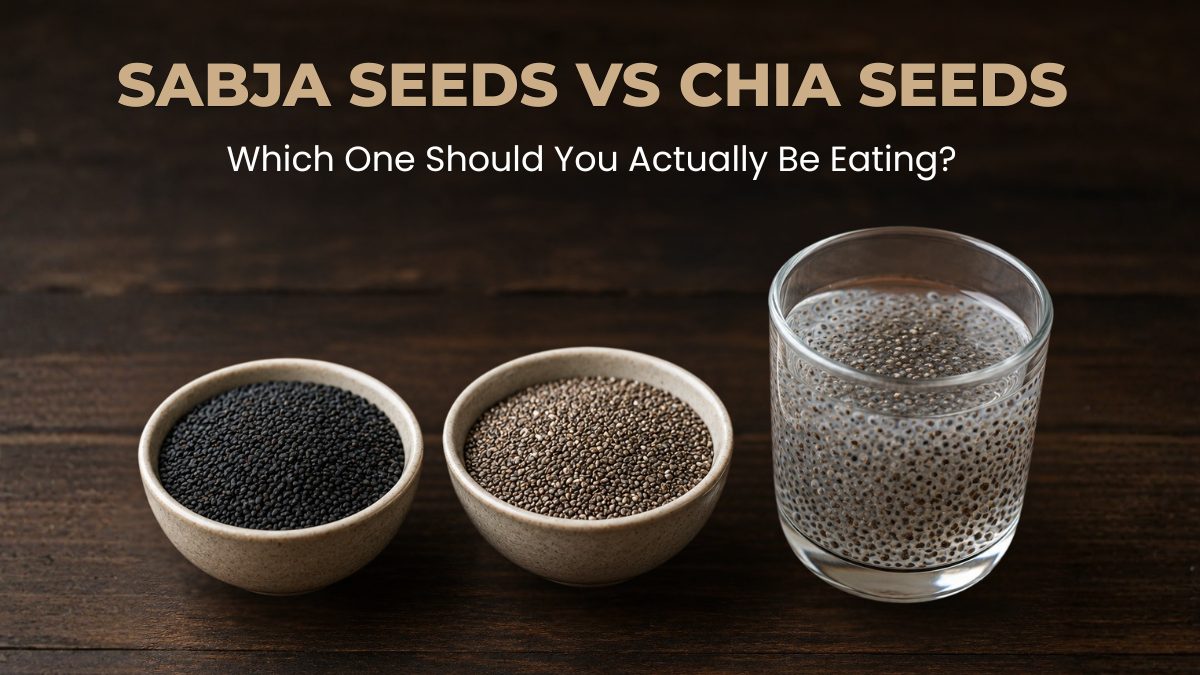
Put sabja seeds and chia seeds side by side and most people cannot tell the difference. Both are tiny, both are black, both swell dramatically in water. But they come from different plants, behave differently in your kitchen, and have meaningfully different nutritional profiles depending on what you are trying to achieve. The confusion between the two is understandable — but the answer to "which one should I use" is not the same for everyone, and "they are basically the same thing" is not accurate.
Quick Answer: Sabja seeds (basil seeds, sweet basil seeds in English, sabja ginjalu in Telugu, sabja ke beej in Hindi) come from Ocimum basilicum — a plant native to India. Chia seeds come from Salvia hispanica — a plant native to Mexico and Guatemala. Both swell in water and form a gel coating. Key differences: sabja swells faster (5 minutes vs 20–30 for chia), sabja must be soaked before eating while chia can be eaten dry, sabja has more iron and calcium while chia has more omega-3 and protein, and sabja costs significantly less in India. For most Indian dietary uses, sabja is the more practical choice. For specific omega-3 or protein supplementation goals, chia has a marginal advantage.
They Are Not the Same Plant — Here Is Why That Matters
The confusion starts because both plants belong to the Lamiaceae family — the mint family. But Ocimum basilicum (sabja's parent plant) and Salvia hispanica (chia's parent plant) are different species with different nutritional compositions, different cultivation origins, and different functional properties when soaked.
Sabja is native to India. It has been cultivated and consumed across the subcontinent for centuries — in falooda, in summer sharbats, in Ayurvedic practice. The plant grows easily in India's tropical climate and the seeds are harvested, dried, and sold inexpensively across Indian markets. When you buy sabja at a local store or online, you are buying an ingredient with a centuries-long Indian food history and a domestic supply chain.
Chia is native to Mexico and Guatemala, historically cultivated by the Aztecs and Mayans. It became a global health food trend in the 2010s and now gets imported into India from South America and Australia. The nutritional profile is genuinely good — this is not a case of imported hype without substance. But it is a product that travels thousands of kilometres to reach your kitchen when a functionally similar and arguably more India-appropriate alternative grows domestically.
The Nutrition Comparison — Where They Are Similar and Where They Diverge
Per 100g dry weight, here is how the two compare on the key numbers that matter for most people:
Fibre: Both are exceptionally high. Sabja seeds contain approximately 37–40g of fibre per 100g. Chia seeds contain approximately 34g per 100g. Sabja has a marginal fibre advantage, though both are well above any other common food in an Indian diet. The type of fibre is similar — both contain significant mucilaginous soluble fibre that gels in water and supports digestion and blood sugar regulation.
Omega-3 fatty acids (ALA): This is chia's clearest nutritional advantage. Chia seeds contain approximately 17–18g of ALA omega-3 per 100g — one of the highest concentrations in any plant food. A 2022 review in Food Science and Nutrition (PubMed) confirmed chia's status as a therapeutic food specifically for its omega-3, fibre, and protein combination. Sabja seeds contain approximately 2.5g of ALA per 100g — meaningful but significantly lower. If supplementing omega-3 is a specific priority, chia has the stronger case.
Protein: Chia edges ahead here too — approximately 17g per 100g versus sabja's 23g per 100g dry weight. Wait — that reverses the conventional narrative. Sabja seeds actually have higher protein per 100g than chia in most analyses, though the practical serving sizes are similar (1–2 teaspoons) and the difference per serving is marginal.
Iron: Sabja seeds contain approximately 17–18mg of iron per 100g — significantly higher than chia's 7–8mg. For vegetarian women who are typically the most iron-deficient demographic in India, this is a meaningful difference. Sabja with lemon (vitamin C for absorption) is a more targeted iron strategy than chia.
Calcium: Sabja leads again — approximately 200–230mg per 100g versus chia's 630mg per 100g. Chia wins here clearly if calcium is the priority. Per tablespoon serving, chia delivers roughly 80mg of calcium versus sabja's 30mg.
Calories: Both are similar — approximately 485–490 kcal per 100g dry. At a practical serving size of one tablespoon (about 13–15g), both deliver approximately 60–70 kcal.
The Practical Differences That Actually Change How You Use Them
Nutrition per 100g matters less than how the seeds actually work in your kitchen. Three practical differences determine which one belongs in your daily routine.
Soaking time: Sabja seeds are fully soaked and ready in 5 minutes. Chia seeds need 20–30 minutes to fully hydrate. For a morning drink, sabja is dramatically more practical — you can prepare it while the kettle boils. Chia's slow soaking works better for overnight preparations: overnight oats, chia pudding left in the fridge.
Must soak vs can eat dry: Sabja seeds cannot be eaten dry — the texture is unpleasant and you skip the gel formation that delivers most of the digestive benefit. Chia seeds can be eaten dry — sprinkled on salads, stirred into yogurt without soaking, mixed into dough or batter. This makes chia more versatile across cooking formats. Sabja belongs primarily in liquids and desserts; chia works across a wider range of applications.
Swelling ratio: Sabja expands to roughly 30–45 times its original size when soaked. Chia expands to roughly 10–12 times. The visual effect in a glass of water is dramatically different — sabja produces the distinctive falooda look that is familiar across Indian dessert culture. Chia produces a more uniform, slightly opaque gel. Neither is superior — this is a texture preference that determines the format each seed suits.
Flavour: Both are nearly neutral. Sabja has a very faint herbal undertone from the basil plant; chia has a very faint nuttiness. Neither changes the taste of any drink or food meaningfully. This is why both work as additions to recipes without altering the final flavour.
Price and Availability — the Honest Reality in India
This is where the comparison becomes most practically relevant for Indian consumers. Sabja seeds typically cost ₹150–300 per 250g in India depending on brand and quality. Chia seeds typically cost ₹350–600 per 250g — sometimes more for imported organic varieties. Sabja is available at most local grocery stores, kirana shops, and supermarkets across India. Chia is primarily available online and at specialty stores in larger cities.
The price difference exists because sabja is domestically produced — Gujarat and Karnataka are major growing regions — while chia is imported. For a daily habit involving one teaspoon per day, the cost difference over a year is significant. For a food that delivers comparable daily fibre benefit at similar serving sizes, paying twice the price for an imported product requires a specific justification — such as the higher omega-3 content if that is what you need.
Which One Is Right for You — the Honest Decision Framework
Choose sabja if: You want a fast daily fibre and iron addition to a morning drink, you are a vegetarian woman specifically looking to improve iron intake, you want a cooling summer drink ingredient with centuries of Indian use behind it, or you want the lower-cost option for the same core digestive benefit. For more on how sabja works specifically and how to prepare it, our post on sabja seeds benefits covers the full picture.
Choose chia if: You specifically want higher ALA omega-3 intake, you prefer eating seeds dry rather than soaking them, you are making overnight preparations like chia pudding or overnight oats where the 30-minute soaking time is not a constraint, or you prefer the uniform gel texture over sabja's crunch-within-gel texture.
Use both if: You want the complete picture — sabja for morning drinks and iron, chia for overnight preparations and omega-3. The two are not substitutes for each other in every context. They suit different formats and different nutritional goals, and including both in a varied diet is the most practical approach.
PureStora carries Ecotyl Basil Seeds (Sabja Seeds) 250g and Ecotyl Chia Seeds 250g — both certified, both verified before listing. Browse the full Food & Beverages range for other high-fibre seed options.
Frequently Asked Questions
Are sabja seeds and chia seeds the same thing?
No — they come from different plants. Sabja seeds come from Ocimum basilicum (sweet basil), native to India. Chia seeds come from Salvia hispanica, native to Mexico and Guatemala. They look similar, both swell in water, and both provide fibre and omega-3 fatty acids — but they are different plants with different nutritional profiles and different practical uses. The confusion is common because both are tiny black seeds that gel in water, but they are not interchangeable in all contexts.
Which has more fibre — sabja or chia?
Sabja seeds have marginally more fibre per 100g — approximately 37–40g versus chia's 34g. At a practical daily serving of one tablespoon (about 13g), the difference is small. Both are exceptional fibre sources by any food comparison standard. If daily fibre is the primary goal, either works — the choice should be based on cost, availability, and how you plan to use them.
Can I substitute sabja seeds for chia seeds in a recipe?
In drinks and liquids — yes, with adjustments. Sabja soaks in 5 minutes and swells much larger, so use slightly less by volume and reduce soaking time. In dry applications — no. Sabja must be soaked before eating; chia can be eaten dry. In baking or recipes where seeds are added without soaking (granola bars, energy balls, crackers), chia works but sabja does not. In overnight preparations, chia is better suited. In summer drinks and Indian desserts like falooda, sabja is the traditional and more appropriate choice.
Which is better for weight loss — sabja or chia?
Both support weight management through the same mechanism: soluble fibre expands in the stomach, increases satiety, and slows glucose absorption, reducing overall calorie intake over time. Neither is a weight-loss product. The satiety effect is comparable between the two at similar serving sizes. Sabja is more practical for morning drinks where the satiety effect is most useful — the 5-minute soaking makes it easier to build a daily habit. For more on high-fibre foods and protein for vegetarian weight management, see our guide on protein rich food for vegetarians in India.
Why are chia seeds more expensive than sabja seeds in India?
Chia seeds are imported — primarily from South America and Australia. Sabja seeds are domestically grown, primarily in Gujarat and Karnataka, with a well-established local supply chain. The import cost, shipping, and distribution markup make chia consistently more expensive. For daily dietary fibre supplementation where the core benefit is comparable, sabja delivers better value per rupee for most Indian consumers. Chia's premium is justified specifically if the higher omega-3 content or the dry-eating versatility is what you need.
Conclusion
Sabja and chia are not the same ingredient, and "use whichever you prefer" is not the full answer. Sabja is faster, cheaper, more iron-rich, and better suited to Indian drink formats. Chia has more omega-3, more calcium, and more versatility in dry applications. The right choice depends on what you are trying to achieve and how you plan to eat them. For most Indian consumers making a daily morning drink habit, sabja is the more practical and economical choice. For omega-3 supplementation or overnight preparations, chia earns its premium. Both are worth having in your kitchen if you have a use for both formats. For certified organic versions of both, browse PureStora's Health & Wellness range.
Disclaimer: This article is for general informational purposes only and is not a substitute for medical or nutritional advice. Nutritional values are approximate and may vary by variety, brand, and processing method.
