
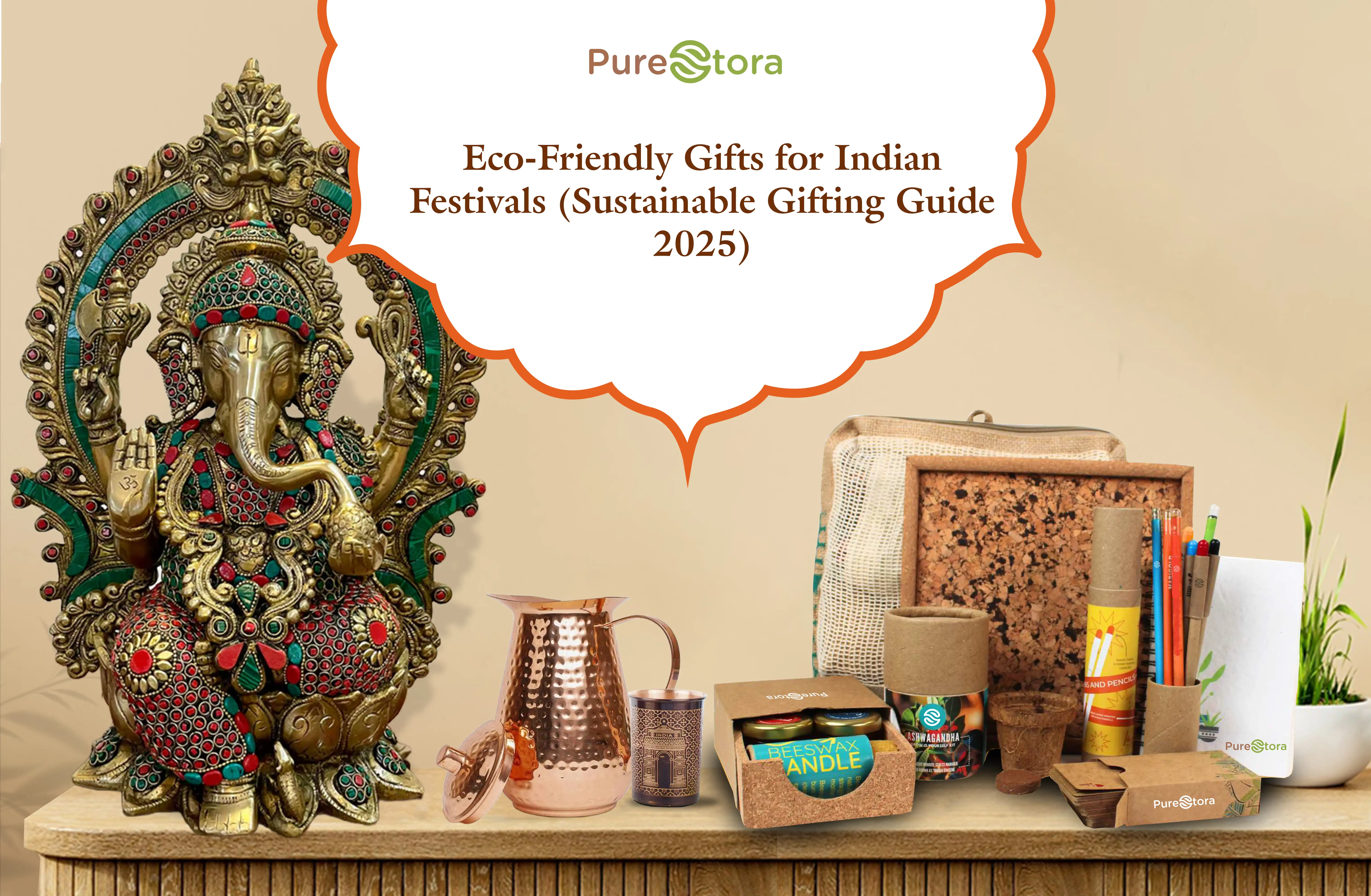
India generates nearly 936,000 tonnes of extra waste during just three days of Diwali. The plastic wrapping, thermocol trays, synthetic ribbons, and disposable gift boxes from a single festival season fill landfills and clog waterways across the country. At the same time, urban Indian households are shifting — 65% now prefer sustainable gifts compared to 52% just two years ago. Eco-friendly gifting is no longer niche; it is where Indian gifting culture is moving. PureStora's zero-waste and natural product range is built specifically for this kind of gifting — useful, certified, and genuinely low-waste.
Quick Answer: The best eco-friendly gifts for Indian festivals fall into five categories: certified organic food and hampers, natural personal care sets, sustainable fashion (organic cotton, handloom), zero-waste kitchen essentials, and handmade or artisan gifts. The key distinction to make before buying: "eco-friendly" as a label has no legal definition in India. Look for actual certifications — FSSAI Organic, India Organic, GOTS (for textiles), or Fair Trade — before paying a premium for any sustainable gift claim. FSSAI's organic food standards govern what can legally carry an organic certification mark in India.
Why Festival Gifting Needs a Rethink
The scale of the problem is concrete. India's Diwali waste alone includes millions of single-use plastic gift boxes, synthetic ribbon, thermocol trays that take hundreds of years to decompose, and firecracker debris. Delhi's PM2.5 — already among the worst in the world — rose to 603 µg/m³ on Diwali night 2024, a 13% increase over the previous year. A significant portion of that is from burning of synthetic materials including gift packaging.
The cultural argument for change is equally strong. Indian festivals — Diwali, Dussehra, Raksha Bandhan, Eid, Pongal — are rooted in principles of giving, gratitude, and community. The mass-produced, plastic-wrapped hamper with synthetic sweets is a relatively recent addition. Handmade, natural, and locally sourced gifts are more aligned with what festivals actually represent than a shrink-wrapped box of chemical-laden mithai.
The practical argument: eco-friendly gifts are increasingly better gifts. A reusable copper bottle, a set of certified organic spices, a handwoven cotton stole — these are gifts people actually use, remember, and appreciate. They are not single-use items that end up in a drawer.
1. Certified Organic Food Gifts and Hampers
Organic food is the most practical and most appreciated category of eco-friendly gifting — because it is immediately usable, genuinely different from conventional alternatives, and the certification is verifiable before purchase.
What makes a genuinely good organic food gift:
- Certified dry fruits — almonds, cashews, walnuts with India Organic or FSSAI Organic mark on the individual packet
- Single-origin organic spices — turmeric, cardamom, saffron from a traceable certified source
- Raw organic honey — unfiltered, with FSSAI licence number
- Organic herbal teas — tulsi, chamomile, or ginger from a certified producer
- Organic jaggery or natural sweeteners — as a refined sugar alternative
The key verification step: check the certification mark on each individual product inside the gift, not just on the outer box. A box labelled "organic" means nothing without verified certification on what is inside. For a detailed guide on building or buying a genuinely certified organic hamper — including how to spot greenwashing in festival gifting — see our complete guide to organic festival hampers in India.
2. Natural Personal Care Gift Sets
Personal care sets — soaps, hair oils, body lotions — are among the most commonly gifted items during Indian festivals. The problem with most conventional sets is that they are full of synthetic fragrances, SLS, and parabens that the recipient uses on their skin daily for years.
Natural personal care gifts that are genuinely useful:
- Handmade cold-process soaps — coconut oil or shea butter base, without SLS or synthetic fragrance. Look for a full ingredient list — if it just says "soap," that is not transparency.
- Organic coconut oil or almond oil — for hair and skin. Unrefined, cold-pressed, certified organic where possible.
- Herbal hair oil sets — brahmi, amla, bhringraj in a carrier oil base from a certified producer
- Natural lip balm or body butter — beeswax or plant wax base without mineral oil or synthetic preservatives
What to avoid: Any personal care gift set where the ingredient list says only "natural ingredients" or "herbal extracts" without naming them. This is the personal care equivalent of writing "organic" on a food box without certification.
PureStora's certified organic personal care range covers soaps, hair care, and skincare from vendors who have submitted ingredient documentation before listing.
3. Handmade and Artisan Gifts — Supporting Indian Craft
Some of the best eco-friendly festival gifts have no certification required — because they are handmade from natural materials by Indian artisans using traditional techniques.
- Clay diyas and pottery — traditionally made terracotta diyas are 100% biodegradable and dissolve back into soil. Buying from local potters supports an artisan community that industrial alternatives have been steadily displacing. Cow-dung diyas from artisan cooperatives are an emerging eco-option that also repels insects naturally.
- Seed paper gifts — greeting cards, bookmarks, or small notepads embedded with seeds (tulsi, marigold, or herbs) that grow when planted. The gift is used twice — first as a card, then as a plant.
- Bamboo and jute products — bamboo cutlery sets, jute tote bags, bamboo trays. Bamboo is one of the fastest-growing renewable materials; jute is fully biodegradable.
- Upcycled home decor — candles in upcycled jars, torans from recycled fabric, lanterns from repurposed materials. Look for products where the upcycling is genuine and traceable, not just a marketing label.
- Potted plants — money plant, tulsi, succulents, or air-purifying indoor plants. A gift that keeps growing after the festival ends and requires no certification to be genuinely eco-friendly.
4. Zero-Waste Kitchen Essentials
Zero-waste kitchen items are practical, long-lasting, and genuinely reduce ongoing plastic consumption in the recipient's home. Unlike decorative gifts that get shelved, these are used daily.
- Stainless steel water bottles and containers — replace single-use plastic across every meal. A good stainless steel bottle lasts 10–20 years.
- Copper water bottles — traditional Indian practice, increasingly backed by research on copper's antimicrobial properties. Functional and culturally rooted.
- Beeswax food wraps — replaces single-use cling film for storing food. Reusable for 6–12 months.
- Bamboo cutting boards — durable, renewable, and do not shed microplastics into food like plastic boards do
- Cloth produce bags — cotton mesh bags for vegetables and fruits, replacing the single-use plastic bags from every market trip
Browse PureStora's natural home essentials range for reusable kitchen and home products from certified vendors.
5. Sustainable Fashion — Organic Cotton and Handloom
Clothing and textiles are a traditional festival gift in India — sarees, kurtas, stoles, and dupattas have been gifted at Diwali, Eid, and weddings for generations. The sustainable version of this tradition is not difficult to find — it just requires knowing what to look for.
- GOTS-certified organic cotton — the Global Organic Textile Standard (GOTS) is the most credible certification for textiles. It covers the entire supply chain from raw cotton to finished garment, ensuring no toxic dyes or chemical processing agents. Look for the GOTS logo on the garment's label.
- Handloom textiles — khadi, handwoven block-printed fabric, or traditional weaves from artisan cooperatives. The Handloom Mark (issued by the Indian government) certifies genuine handloom origin.
- Natural dye fabrics — fabrics dyed with plant-based or mineral dyes rather than synthetic chemical dyes. Indigo, turmeric, and pomegranate rind are traditional Indian dye sources.
PureStora's organic and sustainable fashion range includes certified organic cotton and natural fabric options from verified vendors.
How to Spot Greenwashing in Festival Gifts
The growth of sustainable gifting has brought a corresponding growth in greenwashing — products that use environmental language without substantive environmental credentials.
Red flags in festival gifts claiming to be eco-friendly:
- "Natural" or "eco-friendly" on the label without a named certification — these terms have no legal definition in India
- Recycled paper box on the outside, conventional plastic-wrapped products inside
- "Organic" food items without FSSAI Organic or India Organic mark on the individual product
- Bamboo products that are actually bamboo-composite (bamboo mixed with plastic binders) — check for "100% natural bamboo" specifically
- Handmade claims without any artisan sourcing information — if you cannot find out who made it, the "handmade" claim is unverifiable
The practical test: can you verify the claim independently? Certification marks can be checked. Artisan sourcing can be traced. Ingredient lists can be read. If a product's eco-friendly credentials rely entirely on marketing language and cannot be independently verified, apply the same scepticism you would to any other unverified claim.
Packaging — The Often-Overlooked Part of Eco-Friendly Gifting
A certified organic food product in a thermocol box wrapped in synthetic ribbon is not an eco-friendly gift. The packaging matters as much as what is inside.
Sustainable packaging options for festival gifts:
- Recycled kraft paper — biodegrades in weeks, looks good, widely available
- Cloth wrapping (furoshiki style) — Japanese technique of wrapping gifts in fabric; the wrapping cloth itself becomes part of the gift
- Jute bags or cotton pouches — reusable by the recipient long after the festival
- Banana fibre trays — fully biodegradable alternative to thermocol in gift boxes
- Seed paper tags — the gift tag can be planted and grows into a plant
Frequently Asked Questions
What is the most practical eco-friendly gift for Indian festivals?
Certified organic dry fruits, single-origin organic spices, or a reusable stainless steel bottle are the most universally appreciated eco-friendly festival gifts. They are immediately usable, genuinely different from conventional alternatives, and the certification or material quality is verifiable before purchase. Avoid generic "natural" gift sets without ingredient transparency or certification marks.
How do I verify if an eco-friendly festival gift is genuinely sustainable?
For food: look for FSSAI Organic or India Organic (Jaivik Bharat) mark on each individual product. For textiles: look for GOTS certification or the government Handloom Mark. For cleaning and personal care: read the ingredient list — if it is not disclosed, the product's claims are not verifiable. "Natural" and "eco-friendly" alone are marketing terms with no legal backing in India.
Where can I find genuinely eco-friendly and organic festival gifts in India?
Look for curated platforms that verify vendor certification before listing — not just any marketplace where sellers self-declare organic status. Browse PureStora's natural home essentials and across categories for eco-friendly gifting options where every vendor has submitted certification documentation.
Are eco-friendly festival gifts more expensive than conventional gifts?
Sometimes — but not always, and not by as much as people assume. Certified organic dry fruits carry a 20–40% premium. Handloom fabric is often comparable in price to mass-produced synthetics of similar quality. Stainless steel or copper bottles cost more upfront but last 10–20 years versus a single-use plastic alternative. The price premium is real in some categories and minimal in others — the key is knowing which categories justify it.
Conclusion
Eco-friendly festival gifting is not about perfection or paying double for everything. It is about making verifiable choices in the categories where it matters — food with certification, personal care with ingredient transparency, textiles with traceable sourcing, and packaging that does not outlast the festival by 500 years. The shift is already happening in Indian urban households — the question is whether the gifts you give reflect that shift or contribute to the waste problem instead. For more on switching to lower-synthetic-chemical choices across your home, see our guide on switching to chemical-free household products.
Disclaimer: This article is for general informational purposes only. Certifications mentioned should be verified on individual product packaging before purchase. Environmental data cited is based on published reports and may have changed since publication.
