
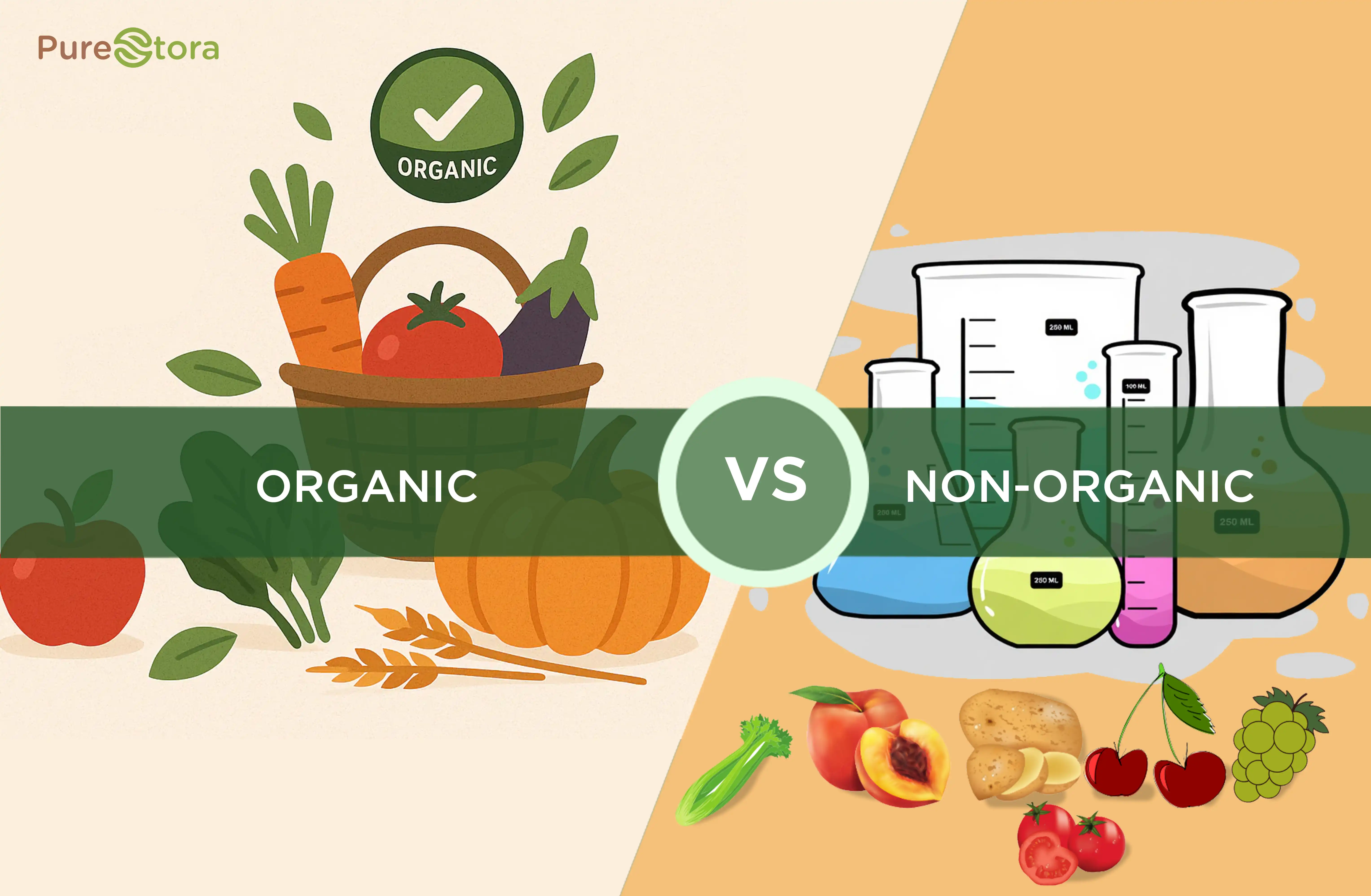
The debate over organic versus conventional vegetables in India often gets stuck on price. That is the wrong starting point. The better question is: what is actually in conventional vegetables sold in India, how does that compare to certified organic, and does the difference matter enough to justify paying more? The answer depends significantly on which vegetable you are buying. PureStora's certified organic food and grocery range includes vegetables and produce where every vendor has been verified for FSSAI Organic or India Organic certification before listing.
Quick Answer: Research on Indian vegetable samples shows approximately one-third of conventional vegetables have detectable pesticide residues, with around 16% exceeding FSSAI's Maximum Residue Levels. Chlorpyrifos — an organophosphate insecticide — is the most commonly detected residue exceeding FSSAI limits. Certified organic vegetables are not guaranteed to be 100% residue-free (drift from neighbouring farms can occur), but they consistently show significantly lower pesticide loads than conventional equivalents. Nutritional differences between organic and conventional vegetables are modest — the primary, most consistent advantage of organic is lower pesticide residue, not higher nutrition.
What "Organic" Actually Means for Vegetables in India
Before comparing organic and conventional, it is worth being precise about what the certification actually guarantees — and what it does not.
FSSAI Organic certification for vegetables means:
- The farm has not used synthetic pesticides, herbicides, or chemical fertilisers for a minimum conversion period (typically 2–3 years)
- The certification has been verified by an accredited third-party inspection body
- The product carries a traceable certification number
What it does not guarantee:
- Zero pesticide residue — spray drift from neighbouring conventional farms, contaminated water sources, or legacy soil contamination can all result in trace residues even on certified organic produce
- Superior nutrition in every case — nutritional differences between organic and conventional vegetables are real but modest, and vary significantly by vegetable type, soil quality, and farming practice
- The claim "100% pesticide-free" is not supported by the certification standard and should not appear on any certified organic product
The terms "natural," "farm-fresh," "chemical-free," and "pesticide-free" on a vegetable label without an FSSAI Organic or India Organic certification mark are unregulated — any seller can use them without proof. Only the certified marks carry verified weight.
The Pesticide Residue Reality in Indian Vegetables
Research on Indian vegetable samples gives a clear picture — and it is more nuanced than either "all conventional vegetables are dangerous" or "residues are not a problem."
Key findings from published research on Indian vegetable samples:
- Approximately one-third of conventional vegetable samples tested across multiple Indian states showed detectable pesticide residues
- Around 16% of samples contained residues above FSSAI Maximum Residue Levels — meaning above the threshold FSSAI considers safe for human consumption
- Chlorpyrifos (an organophosphate insecticide) was the most commonly detected residue exceeding FSSAI limits across vegetable categories
- Banned or withdrawn pesticides including DDT isomers and endosulphan were detected in some samples — indicating either illegal use or legacy soil contamination
- Research published on PubMed found acephate, monocrotophos, ethion, and profenofos were detected in the majority of conventional vegetable samples across multiple Indian states regardless of location
What does this mean in practice? That the majority of conventional vegetables in India are within safe residue limits — but a significant minority are not, and you cannot tell which by looking at them. The organic certification reduces this risk meaningfully, though it does not eliminate it entirely due to drift and environmental contamination.
Which Vegetables Have the Highest Pesticide Risk in India
Not all vegetables are equally sprayed in conventional farming. Understanding which categories carry higher residue risk helps you prioritise where to buy organic.
Higher residue risk — prioritise buying organic:
- Leafy greens — spinach, methi (fenugreek), coriander, curry leaves. Consistently show among the highest pesticide residue levels in FSSAI monitoring. The leaves absorb systemic pesticides directly and cannot be washed off effectively. These are also consumed in concentrated form — coriander and methi go into every dish as flavouring.
- Tomatoes — one of the most heavily sprayed vegetables in India. Tomato crops require frequent pesticide application in conventional farming. Thin skin means residues are not protected by a removable peel.
- Capsicum (bell pepper) — consistently flagged in pesticide monitoring globally and in India for high residue levels. Thin-skinned and grown in protected environments where pesticide use is intensive.
- Cauliflower and cabbage — the layered structure traps pesticide residue that washing does not reach. Profenofos was specifically detected in cauliflower samples in Indian research.
- Brinjal (eggplant) — frequently cited in Indian pesticide monitoring for above-limit residue findings. The spongy flesh absorbs systemic pesticides.
- Grapes and strawberries — technically fruits but sold in vegetable sections; consistently among the highest-residue items in any market globally and in India.
Lower residue risk — conventional is usually fine:
- Onions — the outer layers are discarded; inner layers show much lower residue. Conventional onions are generally low-risk.
- Garlic — similar to onions; outer papery skin is discarded, and the inner clove shows low residue.
- Peas — the pod is discarded; the seed itself is protected and shows lower residue than open-surface vegetables.
- Corn — husk is removed before eating; the kernel shows lower residue.
- Potatoes — peel before eating; most residue stays in the skin. However, if you eat the skin (as in roasted preparations), organic potatoes are worth the switch.
- Pumpkin, bottle gourd, ridge gourd — thick-skinned gourds where the peel is removed before eating; lower net residue exposure for the consumer.
For the spice category — which functions like a concentrated vegetable — the organic case is even stronger. See our post on top organic spices from India for how pesticide residue in spices differs from whole vegetables.
Nutritional Differences — What the Research Actually Shows
The nutrition argument for organic vegetables is frequently overstated. Here is what the evidence actually supports:
Where organic shows an advantage:
- Modestly higher phenolic compound content — antioxidants — in organic fruits and vegetables. Research consistently finds a 20–40% higher concentration of certain antioxidants in organic produce. This is attributed to plants producing more defence compounds when not protected by synthetic pesticides.
- Lower cadmium content in organic cereal crops — cadmium is a heavy metal that accumulates from conventional phosphate fertilisers
- Organic dairy and meat (less relevant for vegetables) show higher omega-3 fatty acid content
Where the evidence is weak or absent:
- The nutritional differences in vegetables are modest and unlikely to be clinically significant for most adults
- Taste differences are difficult to separate from variety and freshness — an organic tomato from a good variety grown locally will taste better than a conventional tomato from an inferior variety grown far away, but the organic factor alone does not guarantee superior taste
- Shelf life differences are real but more related to variety, growing conditions, and storage than organic status alone
The honest conclusion: the primary, most consistently demonstrated advantage of organic vegetables is lower pesticide residue, not higher nutrition. If you are choosing organic primarily for nutritional reasons, the evidence is less compelling than if you are choosing it to reduce pesticide exposure.
The Children and Pregnancy Consideration
One area where the organic-versus-conventional decision carries the most weight is for children and during pregnancy.
Research published in peer-reviewed journals has reported associations between certain pesticide exposures during pregnancy and early childhood with effects on cognitive development — specifically with organophosphate pesticides like chlorpyrifos, which is the same compound most commonly found exceeding FSSAI limits in Indian vegetable samples.
This does not mean conventional vegetables cause developmental harm in children at current exposure levels — the evidence on this is correlational, not conclusive. But it does mean the precautionary case for organic is strongest for this group. For households with young children or during pregnancy, prioritising organic leafy greens and tomatoes is a reasonable precautionary decision supported by the available evidence.
How to Verify Organic Vegetables Are Actually Certified
The Indian vegetable market has a significant greenwashing problem. Vendors at organic markets, apartment delivery services, and even supermarkets frequently use "organic" as a description without any certification backing. Here is how to verify:
- Ask for the certification mark — FSSAI Organic or India Organic (Jaivik Bharat) must be on the packaging or the vendor must be able to show their certification document. If they cannot, the organic claim is unverified.
- Check for the FSSAI licence number — mandatory on all packaged food including packaged organic vegetables. Absence is a red flag.
- Verify the vendor, not just the product — for loose vegetables at a market, the vendor's farm certification matters. Ask which certifying body audits them and whether you can see the certificate.
- Be sceptical of price that seems too low — genuine organic certification involves audit costs and lower yields. Certified organic vegetables that are priced the same as conventional are worth questioning.
At PureStora, this is why the onboarding process requires certification documentation before any vendor is listed — the verification happens before the product reaches you, not after you have already paid for it. For a broader guide on whether organic food is worth the premium across all food categories, see our post on whether organic food is worth the price in India.
Does Washing Remove Pesticide Residue From Vegetables?
This is one of the most common questions — and the honest answer is: partially, but not sufficiently for high-residue vegetables.
What washing effectively removes:
- Surface residues from contact pesticides — those that sit on the vegetable surface rather than being absorbed into the tissue
- Dust, soil, and physical contaminants
What washing does not effectively remove:
- Systemic pesticides — these are absorbed into the plant tissue through roots or leaves and are present throughout the vegetable, not just on the surface. They cannot be washed off because they are inside the vegetable.
- Residues in the crevices of leafy greens, cauliflower florets, or the stem end of capsicum — physical structure prevents water contact
Research reviewing washing protocols found that conventional washing reduces surface pesticide residue but does not eliminate systemic residues. For high-residue vegetables like leafy greens and tomatoes, washing reduces but does not resolve the residue concern.
The Price Premium — Is It Justified?
Organic vegetables typically cost 20–50% more than conventional equivalents in India. The premium is real and reflects genuine cost drivers:
- Third-party certification audit costs (annual)
- Lower yield per acre without synthetic inputs — typically 20–25% less
- Higher labour cost for manual pest control and weeding
- Segregated storage and transport to prevent cross-contamination
The premium is most justified where residue risk is highest: leafy greens, tomatoes, capsicum, cauliflower, and brinjal. For thick-skinned or peeled vegetables like onions, potatoes (if peeled), and gourds, the conventional option is a reasonable choice that does not meaningfully compromise the health case.
Frequently Asked Questions
Are certified organic vegetables truly pesticide-free?
No — and this is an important distinction. Certified organic vegetables are grown without synthetic pesticides, but trace residues can occur from spray drift from neighbouring conventional farms, contaminated irrigation water, or legacy soil contamination. Research consistently shows organic vegetables have significantly lower pesticide loads than conventional equivalents — but "pesticide-free" is not an accurate claim for even certified organic produce. Any product making a "100% pesticide-free" claim is overstating what organic certification guarantees.
Which vegetables should I prioritise buying organic in India?
In order of priority: leafy greens (spinach, methi, coriander), tomatoes, capsicum, cauliflower, and brinjal. These consistently show the highest conventional residue levels in Indian research and are either thin-skinned or have structure that traps residues that washing cannot reach. Onions, potatoes (if peeled), garlic, and thick-skinned gourds are lower-priority categories where conventional is a reasonable choice.
Does washing vegetables remove pesticide residues effectively?
Partially — washing removes surface residues from contact pesticides but does not remove systemic pesticides, which are absorbed into the plant tissue and cannot be washed off. For high-risk vegetables like leafy greens and tomatoes, washing is useful but insufficient. For lower-risk thick-skinned vegetables, washing and peeling together significantly reduce residue exposure. Browse PureStora's health and wellness range for certified organic supplements and superfoods that complement a lower-residue diet.
Are organic vegetables always more nutritious than conventional vegetables in India?
Not always, and the differences are modest. Research shows organic produce has modestly higher concentrations of certain antioxidants (20–40% higher phenolic compounds on average) and lower cadmium levels in cereal crops. However, these differences are unlikely to be clinically significant for most adults. The stronger, more consistent advantage of organic vegetables is lower pesticide residue, not measurably superior nutrition in every category.
Conclusion
The organic versus conventional vegetable debate in India is not binary. The honest answer is that certified organic matters most for high-residue vegetables — leafy greens, tomatoes, capsicum, cauliflower, and brinjal — where pesticide exposure is highest and where washing does not adequately remove systemic residues. For thick-skinned or peeled vegetables, the conventional option is a reasonable choice. The most important protection against greenwashing is the certification mark — FSSAI Organic or India Organic — on the individual product or verifiable on the vendor. For building a complete organic kitchen around these priorities, see our guide on the best organic grocery items for Indian kitchens.
Disclaimer: This article is for general informational purposes only and is not a substitute for medical or nutritional advice. Research findings cited are based on published peer-reviewed studies. Pesticide residue levels vary by crop variety, region, season, and farming practice. FSSAI Maximum Residue Levels represent regulatory thresholds and do not imply zero health risk at or below those levels.
