
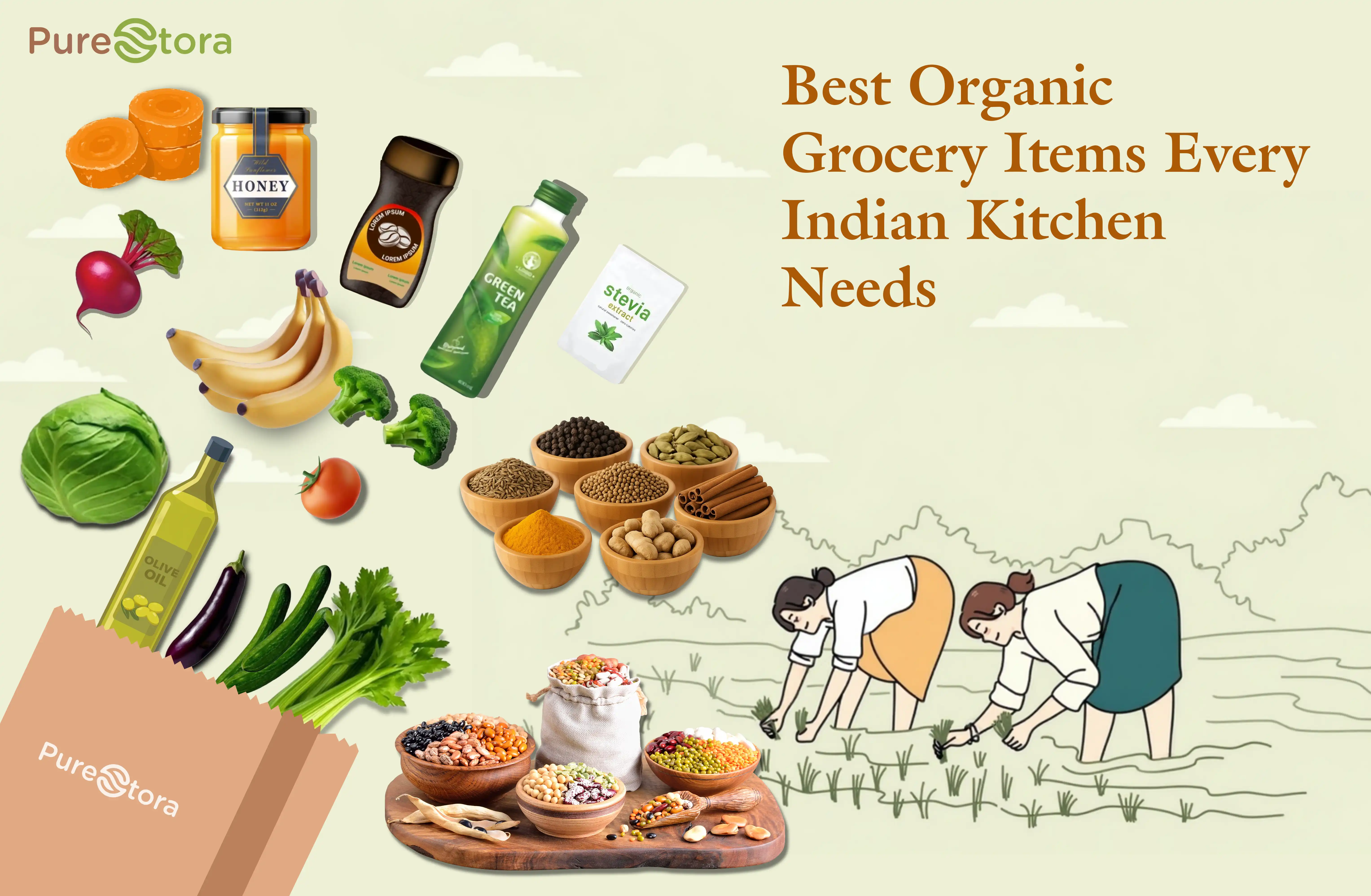
Not everything in your kitchen needs to be organic. But some things do — specifically the items you consume daily, in large quantities, with no ability to wash or peel away pesticide residue before eating. Starting with the right categories gives you most of the benefit without replacing your entire grocery list. PureStora's certified organic food and grocery range covers all the categories below — every vendor verified for FSSAI Organic or India Organic certification before listing.
Quick Answer: The organic grocery items most worth switching to in an Indian kitchen are — in priority order — daily cooking oils, pulses and lentils, spices, rice and grains, natural sweeteners, and herbal beverages. These are the items consumed daily in large quantities where pesticide residue accumulates fastest. According to FSSAI's organic food standards, only products carrying FSSAI Organic or India Organic (Jaivik Bharat) certification have been independently verified as free from synthetic pesticides. "Natural," "farm-fresh," and "chemical-free" on a label without certification mean nothing verifiable.
How to Prioritise — The Indian Kitchen Organic Framework
Before going category by category, a practical framework: the organic premium makes the most sense where daily consumption volume is highest and where pesticide residue cannot be removed before eating.
For Indian kitchens, that prioritisation looks like this:
- Tier 1 — Always buy organic: Cooking oils, pulses and lentils, spices, rice. These go into every meal, every day, often twice. The cumulative pesticide exposure from these items over a year dwarfs anything else in your kitchen.
- Tier 2 — Buy organic when budget allows: Whole grains and millets, natural sweeteners, herbal teas, dry fruits and nuts
- Tier 3 — Conventional is usually fine: Thick-peeled produce (onions, potatoes, bananas, coconut), heavily processed items regardless of organic label
This framework lets you make targeted switches that have real impact, rather than switching everything at once and giving up because of cost.
1. Organic Pulses and Lentils — The Non-Negotiable
Dal is cooked twice a day in most Indian households. That makes it the single highest-volume food in the Indian diet — and therefore the item where pesticide residue accumulates fastest with conventional farming.
The most used pulses in Indian kitchens:
- Masoor dal — approximately 25g protein per 100g dry weight, fastest-cooking lentil, used daily across India
- Moong dal — approximately 24g protein per 100g, easily digestible, used in khichdi, soups, and dosas
- Chana dal — approximately 22g protein per 100g, used in curries, chutneys, and tadkas
- Toor dal (arhar) — the base of sambar and most South Indian cuisine
- Rajma and chole — used weekly in most North Indian households
Organic certification for pulses means third-party verification that no synthetic pesticides or fertilisers were used. The protein content is similar to conventional — the difference is what is absent, not what is added. For the most consumed food in your daily diet, that absence matters cumulatively.
How to choose: FSSAI Organic or India Organic mark on the individual packet. Avoid bulk bins without certification documentation — you cannot verify what you cannot trace. For more on organic protein sources including pulses, see our detailed guide on organic protein sources for vegetarians in India.
2. Cold-Pressed Organic Cooking Oils
Most cooking oil in Indian kitchens is refined — meaning it has been processed with hexane (a petroleum-derived solvent), bleached, and deodorised at high temperatures. Cold-pressed oil skips all of that. The seeds are pressed mechanically at low temperature, retaining natural antioxidants, flavour compounds, and the oil's original fatty acid profile.
The oils most used in Indian cooking — and why cold-pressed organic versions are worth the switch:
- Groundnut oil — the most widely used cooking oil in South India. Cold-pressed groundnut oil has a distinct nutty flavour and higher natural antioxidant content than refined versions.
- Mustard oil — used across North and East India for cooking and pickling. Cold-pressed mustard oil retains its pungent allyl isothiocyanate content — the compound responsible for its characteristic flavour and traditional medicinal use.
- Sesame oil — used in South Indian cooking and Ayurvedic preparations. Cold-pressed sesame oil is significantly richer in sesamin and sesamolin — natural antioxidants that make it more heat-stable than most plant oils.
- Coconut oil — Virgin (cold-pressed) coconut oil retains medium-chain triglycerides and lauric acid that are partially degraded in refined coconut oil.
How to choose: Look for "cold-pressed" or "wood-pressed" (chakku) on the label — not just "organic." Both are necessary. The oil should have a natural aroma — refined oil is odourless by design. FSSAI Organic certification covers the agricultural origin; cold-pressed describes the processing method. You need both.
3. Organic Spices — The Highest Priority Switch
Spices are consumed in powdered, concentrated form — every day, in every meal. They cannot be washed, peeled, or prepared in a way that removes residue. Conventional spice crops in India are among the most heavily managed with chemical inputs, and grinding concentrates whatever is in the spice into the food directly.
The core spices every Indian kitchen uses daily:
- Turmeric (haldi) — in every dal, curry, and sabzi. Look for single-origin varieties — Lakadong turmeric from Meghalaya carries 6–7% curcumin versus 2–3% in standard commercial versions.
- Cumin (jeera) — in every tadka. Whole seeds retain volatile compounds better than pre-ground.
- Coriander (dhaniya) — consistently flagged in FSSAI testing for high residue levels in conventional form.
- Red chilli powder — one of the most adulterated spices in India. Certified organic with FSSAI licence number is the minimum verification.
- Black pepper — pairs with turmeric to significantly enhance curcumin absorption.
For a complete guide to choosing and using organic spices from India, including how to identify adulteration and what single-origin means in practice, see our post on top organic spices from India.
4. Organic Rice and Whole Grains
Rice is the most consumed grain in India — and one of the most pesticide-intensive crops in conventional farming. Organic rice is grown without synthetic pesticides or fertilisers, and in certified organic farming, water management and soil health are also governed by the certification standard.
Beyond rice, the grain category worth prioritising organically:
- Organic basmati rice — India is the world's largest basmati exporter. Certified organic basmati carries FSSAI Organic or India Organic mark and often traceable origin.
- Organic millets — ragi, jowar, bajra, kodo. Millets are experiencing a major resurgence in Indian kitchens in 2026, with millet-based foods growing at 35% as health-conscious families rediscover traditional Indian grains. They are naturally more pest-resistant than wheat or rice, making the organic premium smaller in this category.
- Organic wheat and wheat flour (atta) — used daily for rotis across most of India. Organic atta from certified sources means the grain was grown without synthetic inputs and milled without chemical bleaching agents.
How to choose: For rice, look for FSSAI Organic or India Organic mark and origin labelling. For millets, the organic certification is the primary check — millets are naturally hardier crops and the conventional vs organic quality gap is smaller than for rice or wheat.
5. Natural Sweeteners Over Refined Sugar
Refined white sugar is not a high-pesticide-risk product in the same way pulses or spices are — it is heavily processed, which strips most residue. The case for switching sweeteners is less about pesticide residue and more about what you are switching to.
Natural sweeteners worth keeping in an Indian kitchen:
- Organic jaggery (gud) — unrefined cane sugar concentrate. Retains iron, calcium, and potassium that are stripped during white sugar refining. Not a health food in large quantities — but a meaningfully better daily sweetener for chai, ladoo, and chutney.
- Raw organic honey — unfiltered, unpasteurised. Retains enzymes and trace compounds destroyed by heat processing. Look for "raw" and "unfiltered" specifically — just "organic honey" can still be heat-treated.
- Coconut sugar — lower glycaemic index than refined sugar, retains trace minerals. A direct substitution in most Indian sweets and baking.
- Date syrup or date paste — whole fruit sweetener with fibre intact. Useful in smoothies, energy balls, and desserts.
How to choose: For jaggery, look for FSSAI Organic certification and "chemical-free processing" — conventional jaggery is often treated with sodium hydrosulphite (a bleaching agent) to achieve a lighter colour. Real organic jaggery is dark brown to golden, not pale.
6. Organic Breakfast Staples
The Indian breakfast is changing rapidly. Beyond the traditional idli-dosa-paratha circuit, urban households increasingly consume oats, granola, muesli, and millet-based porridge. Clean labels and nutrient density are reshaping formulations in 2026 — and the breakfast segment is where this shift is most visible.
Organic breakfast staples worth stocking:
- Organic rolled oats — one of the most pesticide-intensive conventional crops globally (oats are often treated with glyphosate pre-harvest). Certified organic oats are the highest-priority breakfast switch.
- Organic millet granola — combines the millet revival with the growing granola habit. Look for versions with no refined sugar — jaggery or date syrup sweetened.
- Organic multigrain dalia (broken wheat/millet porridge) — traditional Indian breakfast with high fibre and protein content. Organic versions use certified grains without synthetic additives.
PureStora carries certified organic millet granola with fruit and nuts — a clean, no-refined-sugar breakfast option made from verified organic ingredients.
7. Organic Herbal Teas and Beverages
Most Indian households drink chai multiple times a day. Conventional tea is one of the most pesticide-intensive crops globally — tea leaves are picked in concentrated form and dried without washing. Residue stays in the leaf and enters your cup.
Beverage switches worth making:
- Organic green or black tea — look for Darjeeling or Assam certified organic. India Organic or FSSAI Organic mark on the tin.
- Organic herbal teas — tulsi, chamomile, ginger, ashwagandha. Herbal infusions steep directly in water with no other processing — whatever residue is on the herb goes into your cup.
- Organic coffee — for filter coffee households in South India. Certified organic Arabica or Robusta from Coorg or Chikmagalur is increasingly available online.
How to choose: Loose leaf over tea bags where possible — tea bags are often made from plastic-containing mesh that releases microplastics in hot water. For herbal teas specifically, the organic certification matters more than for black tea because herbal infusions are consumed whole without milk or sugar to dilute whatever is in the leaf.
8. Organic Dry Fruits and Nuts
Dry fruits are consumed daily in most Indian households — a handful of almonds in the morning, cashews in a curry, raisins in kheer. They are also among the most adulterated categories in the Indian grocery market — sulphur treatment for colour preservation, coating with mineral oil for shine, and blending of different grades are common practices in conventional dry fruits.
- Almonds — approximately 21g protein per 100g. Look for India Organic mark. Organic almonds are not treated with sulphur dioxide for preservation.
- Cashews — India is one of the world's largest cashew producers. Organic certification covers the farming practice — also check for no added salt or oil in the processing.
- Walnuts — approximately 15g protein per 100g, rich in omega-3 fatty acids. Conventional walnut orchards are heavily sprayed — organic certification here carries real value.
- Raisins — conventionally treated with sulphur dioxide for colour preservation. Organic raisins are darker and less visually uniform but without sulphur treatment.
How to choose: Look for FSSAI Organic or India Organic certification. Suspicious uniformity of colour is a red flag — organic dry fruits show natural variation. Avoid anything with added oil, sugar, or salt unless stated on the ingredient list.
What to Check on Every Organic Grocery Label
Before paying any organic premium, verify these four things on the label:
- Certification mark — FSSAI Organic or India Organic (Jaivik Bharat) on the individual product. Not on the brand website. Not on the outer packaging only. On the product itself.
- FSSAI licence number — mandatory on all packaged food sold in India. Absence of this number is a red flag regardless of certification claims.
- Ingredient list — for processed organic products, read every ingredient. "Organic" on the front label with non-organic additives listed inside is a partial claim, not a full one.
- Processing method — for oils, "cold-pressed" or "wood-pressed" is separate from organic certification. For honey, "raw" and "unfiltered" matter beyond just organic. For spices, "single-origin" matters as much as certification.
Frequently Asked Questions
Which organic grocery items should I start with in an Indian kitchen?
Start with daily cooking oil, pulses, and spices — in that order. These three categories are consumed daily in large quantities with no ability to wash away residue, making them the highest cumulative exposure items in the Indian diet. Once switched, maintain them consistently and expand to rice, grains, and sweeteners as budget allows.
Are organic pulses and dal worth the price premium in India?
Yes — for daily consumption items like dal specifically. The protein content is similar to conventional. The difference is the absence of synthetic pesticide residue from crops consumed twice a day, every day. Over a year of daily consumption, the cumulative residue difference between organic and conventional dal is significant. The premium for most organic pulses is 20–40% — for a daily staple, that is a meaningful but manageable cost increase.
How do I verify if an organic grocery product is genuinely certified in India?
Look for the FSSAI Organic or Jaivik Bharat (India Organic) mark on the individual product packaging — not just on the brand's website or marketing. Check for the FSSAI licence number on all packaged food. "Natural," "chemical-free," and "farm-fresh" are unregulated terms with no legal backing. Browse PureStora's certified organic health and wellness range to see what genuine certification looks like on verified product labels.
Is organic food from online stores genuinely certified or just labelled that way?
It depends entirely on the platform. Curated organic marketplaces that verify vendor certification before listing are significantly more reliable than general e-commerce platforms where sellers self-declare organic status. At PureStora, every vendor submits FSSAI Organic or India Organic certification documentation before any product is listed — the certification is the gate, not an afterthought.
Conclusion
An organic Indian kitchen does not require switching everything at once. It requires switching the right things — daily staples, cooking oils, and spices first, then grains and sweeteners, then beverages and dry fruits as budget allows. The cumulative impact of those targeted switches on your household's daily pesticide exposure is significant even when you leave thick-peeled produce and processed foods on the conventional shelf. For context on where the organic premium is and is not justified across your broader shopping, see our guide on whether organic food is worth the price in India.
Disclaimer: This article is for general informational purposes only and is not a substitute for medical or nutritional advice. Nutritional values cited are approximate and may vary by variety, brand, and processing method. Product certifications should be verified on individual packaging before purchase.
