If you notice in any Indian supermarket and you will find dozens of products labelled "organic," "natural," or "chemical-free." Most carry some kind of logo or seal. Very few Indian consumers know which of those logos actually means something — and which ones are legally meaningless.
India has 3 government-recognised organic certification systems. If a product does not carry one of these marks, its organic claim is unverified — regardless of how the packaging looks or what the brand says about itself.
The 3 Official Organic Certification Marks in India
Before checking any label, you need to know what you are looking for. These are the only three marks that carry legal weight under India's Food Safety and Standards (Organic Foods) Regulations, 2017:
1. Jaivik Bharat
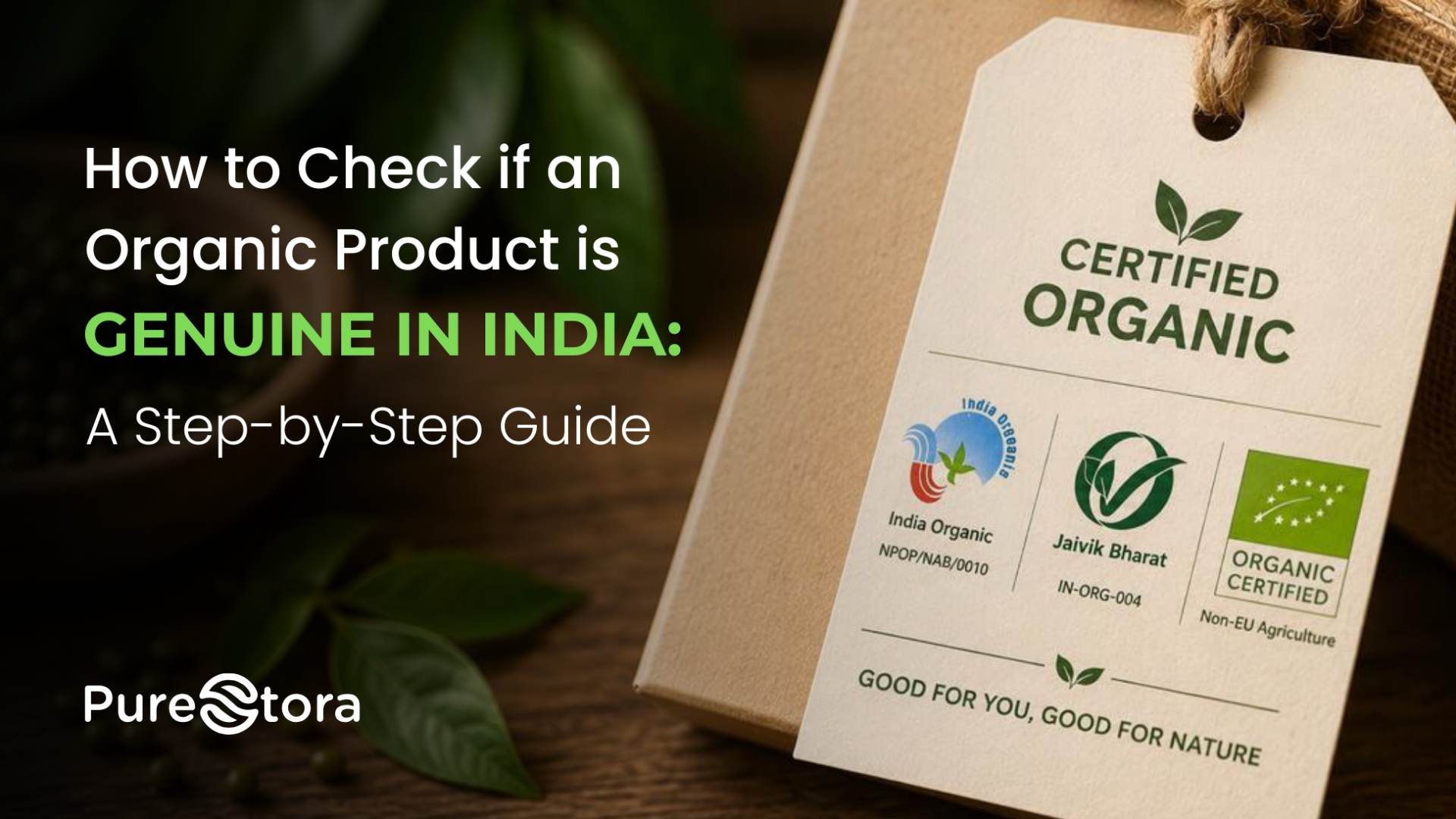
The Jaivik Bharat logo is the unified organic identity mark issued by FSSAI. It is a green checkmark inside a leaf design with "Jaivik Bharat" written below. FSSAI mandates that any product sold as organic in India must carry this logo — whether it is certified under NPOP or PGS-India. Think of it as the overarching umbrella mark. If a product claims to be organic but does not have this logo, that is an immediate red flag.
2. India Organic (NPOP)
The India Organic logo — a dark brown circular mark — indicates certification under the National Programme for Organic Production (NPOP), managed by APEDA under the Ministry of Commerce. NPOP involves third-party accredited certification bodies and is the standard used for commercially processed and exported organic goods. It is the more rigorous of the two certification pathways. Products certified under NPOP carry both the India Organic mark and the Jaivik Bharat logo.
3. PGS-India Organic
PGS-India stands for Participatory Guarantee System — a community-driven certification system managed by the Ministry of Agriculture. It was designed specifically for small and marginal farmers who cannot afford the costs of third-party NPOP certification. PGS-India operates through 563 regional councils across the country and is locally verified rather than independently audited. Products certified under PGS-India carry either a "PGS-India Organic" or "PGS-India Green" logo along with the Jaivik Bharat mark. PGS-India Green indicates the farm is still in conversion — not yet fully organic.
A practical note: NPOP-certified products have passed third-party audits. PGS-India certified products have passed community-level verification. Both are legally valid. For processed or high-value products, NPOP is the stronger assurance. For fresh produce from local farmer groups, PGS-India is legitimate and trustworthy.
Words That Mean Nothing Legally in India
This is where most consumers get misled. The following words and phrases carry zero legal meaning under Indian food regulations — any brand can print them on packaging without any certification or evidence:
- "Natural"
- "Pure"
- "Chemical-free"
- "Farm fresh"
- "Traditional"
- "Preservative-free" (unless tested and verified)
- "Eco-friendly" (without a recognised third-party certification)
- "Sustainably sourced" (without disclosed evidence)
India's Central Consumer Protection Authority finalised the Guidelines for Prevention and Regulation of Greenwashing and Misleading Environmental Claims in 2024 — which explicitly requires that words like "organic," "natural," and "sustainable" must be backed by verifiable certification. But enforcement at the product label level is still catching up. The consumer remains the last line of defence.
How to Verify a Product in 4 Steps — On the Shelf
Here is the exact process to follow when picking up any product claiming to be organic:
- Check for the Jaivik Bharat logo — it should be clearly visible on the front or back of the pack. No Jaivik Bharat logo = unverified organic claim. Full stop.
- Check for India Organic or PGS-India mark — one of these must appear alongside Jaivik Bharat. The Jaivik Bharat logo alone without the underlying certification mark means the product may not have completed full certification.
- Check for FSSAI licence number — mandatory on all packaged food products in India. A missing FSSAI number is a compliance failure, not just a red flag for organic claims. It applies to all food products regardless of organic status.
- Verify on the Jaivik Bharat portal — for products you buy regularly, go to FSSAI's official Jaivik Bharat portal and search the brand or product name in the organic integrity database. This is the most reliable verification step — and most consumers have never done it.
What the Jaivik Bharat Portal Actually Lets You Do
The Jaivik Bharat portal is a joint database built by FSSAI, APEDA, and PGS-India that contains information on every registered organic food business operator in India. It is publicly accessible and free to use.
On the portal you can:
- Search by product name or company name
- Verify whether a brand holds a valid organic certification
- Check the certification type (NPOP or PGS-India) and the certifying body
- See the geographical area and products covered under the certification
If you search a brand that claims to be organic and it does not appear in this database — that certification claim is unverified. This is the single most powerful verification tool available to Indian consumers, and it is almost entirely unused.
How Greenwashing Works on Organic Labels — Real Patterns to Spot
Greenwashing in the Indian organic food space follows a few predictable patterns. Knowing them makes them easy to spot:
- Look-alike logos — circular green logos designed to resemble official certification marks without being one. Always check the exact logo against the three official marks described above
- "Certified organic" without a named certifying body — certification always comes from a named, accredited certifying body (e.g. Control Union, Ecocert, OneCert). "Certified organic" on a label with no certifying body named is a vague claim
- Partial ingredient claims — "made with organic ingredients" does not mean the product is fully organic. Under FSSAI regulations, a product can only carry the Jaivik Bharat logo if at least 95% of its agricultural ingredients are certified organic
- Imported certification on domestic products — USDA Organic and EU Organic are valid certifications for imported products. But an Indian-produced product carrying USDA Organic without also carrying Jaivik Bharat may not be compliant with Indian organic regulations for domestic sale
What PureStora Checks Before Listing Any Product
Every vendor on PureStora is verified for valid organic certification before their products go live on the platform. This means checking the FSSAI licence number, the Jaivik Bharat or India Organic certification status, and confirming that the certification is current — not expired.
This is not standard practice across Indian online marketplaces. Most platforms list products based on seller-submitted information without independent verification. You can browse verified certified organic food products and certified organic personal care products on PureStora — every product has passed this check before listing.
Frequently Asked Questions
What is the Jaivik Bharat logo and why does it matter?
Jaivik Bharat is the unified organic identity mark issued by FSSAI. It is mandatory on any product sold as organic in India under the Food Safety and Standards (Organic Foods) Regulations, 2017. Its absence on a product claiming to be organic means the organic claim has not been officially verified under Indian food law.
What is the difference between India Organic and PGS-India certification?
India Organic (NPOP) involves third-party accredited certification and is used for commercially processed and exported organic products — it is the more rigorous pathway. PGS-India is a community-driven certification designed for small and marginal farmers — it is locally verified rather than independently audited. Both are legally valid under Indian organic food regulations. Both require the Jaivik Bharat logo to appear on the product alongside the respective mark.
How do I verify if a product is genuinely organic before buying?
Check for the Jaivik Bharat logo, the India Organic or PGS-India mark, and a valid FSSAI licence number on the packaging. For products you buy regularly, search the brand name on FSSAI's Jaivik Bharat portal to confirm the certification is registered and current. On PureStora, every listed health and wellness product has been verified for valid certification before going live.
Are "natural" and "chemical-free" labels regulated in India?
No — these terms carry no legal definition or regulatory requirement under Indian food law. Any brand can use them without certification or evidence. India's CCPA Greenwashing Guidelines 2024 require environmental claims to be backed by verifiable evidence, but enforcement at the product label level is still developing. The only reliable indicator for organic claims remains the Jaivik Bharat logo alongside a valid NPOP or PGS-India certification mark.
Does a product need both the Jaivik Bharat logo and India Organic mark?
Yes — for NPOP-certified products, both the Jaivik Bharat logo and the India Organic mark should appear. The Jaivik Bharat logo is the overarching FSSAI mark; the India Organic or PGS-India mark shows the specific certification pathway. A product showing only one without the other may not have completed the full certification process.
Conclusion
The organic label problem in India is not a lack of regulation — the framework exists. It is a lack of consumer awareness about what those regulations actually require on a label. Three marks. One portal. That is all it takes to verify any organic claim in India. For more on how these certification standards apply to specific product categories — from grains to cooking oils — our guide on what certified organic means for the food you eat daily covers the practical implications.
This article is for general informational purposes only. Certification information is based on publicly available FSSAI regulations and guidelines as of May 2026. Regulations may be updated — always verify current certification status on the official Jaivik Bharat portal.
