
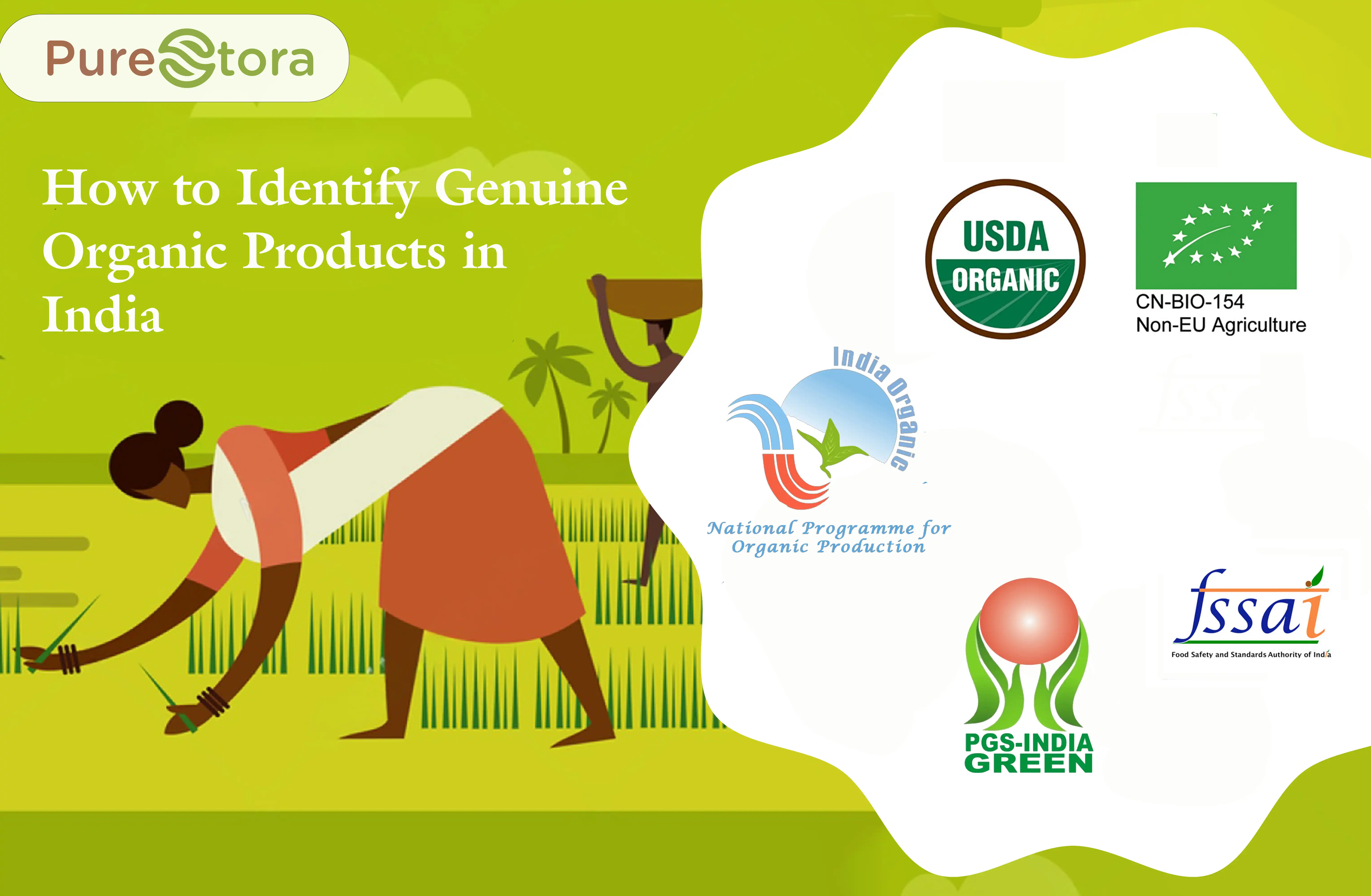
Walk through any supermarket or organic market in India and you will find products labelled "natural," "farm-fresh," "chemical-free," "herbal," and "pure." None of these terms have any legal definition under FSSAI regulations. Any brand can print them on packaging without proof, certification, or inspection. This is the core of India's organic greenwashing problem — and it is why knowing how to verify genuine organic certification matters more than taking any label at face value. At PureStora, every vendor submits FSSAI Organic or India Organic certification documentation before any product is listed in our certified organic food range — the verification happens before you see the product, not after you have already bought it.
Quick Answer: To verify a genuine organic product in India, look for the Jaivik Bharat logo — FSSAI's unified organic mark — along with the FSSAI licence number on the packaging. Additional marks you may see: India Organic logo (NPOP certification, for products sold domestically and for export) and PGS-India logo (Participatory Guarantee System, for domestically sold products from small farmer groups). You can verify any certified product by entering its certification number into the Indian Organic Integrity Database at jaivikbharat.fssai.gov.in. FSSAI's April 2026 advisory confirmed that "organic" is a legally regulated term in India — products without verified certification marks cannot legally use it.
Why Fake Organic Labels Are So Common in India
The Indian organic food market is growing at over 20% annually. Where there is rapid growth and premium pricing, there is incentive for misrepresentation. The problem is compounded by three structural issues:
- Unregulated terminology — "natural," "farm-fresh," "herbal," "chemical-free," and "pesticide-free" are unregulated. FSSAI regulations only control the word "organic" and the certified logos. Everything else is fair game for any brand.
- Weak retail enforcement — India's food safety enforcement is improving but remains inconsistent. Mislabelled products reach shelves at organic markets, general kirana stores, and e-commerce platforms faster than inspection can catch them.
- Consumer trust in visual cues — kraft paper packaging, earthy colours, and handwritten-style fonts signal "organic" to most consumers. None of these visual elements have any regulatory basis.
The result is a market where genuine certified products compete on shelf space with products that look similar but carry no certification. For buyers, the only protection is knowing exactly what to look for — and ignoring everything that is not it.
The Three Certification Marks That Actually Matter in India
India has a specific, legally defined set of certification marks for organic products under the Food Safety and Standards (Organic Foods) Regulations, 2017. Only products carrying one of these marks can legally be sold as organic.
1. Jaivik Bharat Logo
This is FSSAI's unified organic logo — introduced to reduce confusion across multiple certification systems. It features a green checkmark within a leaf, with "Jaivik Bharat" at the bottom. This is the primary mark to look for on any organic product sold in India, regardless of which underlying certification system the product was certified under. FSSAI mandates that any product sold as organic must carry this logo. If it is absent, the organic claim is not legally supported — regardless of what else the packaging says.
2. India Organic Logo (NPOP)
The India Organic logo indicates certification under the National Programme for Organic Production (NPOP), implemented by APEDA under the Ministry of Commerce and Industry. NPOP is the third-party certification system — an accredited inspection body independently verifies the farm, the processing unit, and the supply chain before certification is granted. NPOP-certified products can be sold both domestically and for export. This logo often appears alongside the Jaivik Bharat logo on commercial organic products.
3. PGS-India Logo
PGS (Participatory Guarantee System) India is a community-driven certification system administered by the Ministry of Agriculture and Farmers Welfare. It is designed for small and marginal farmers who sell directly to consumers — typically at local organic markets, farmer cooperatives, and community agriculture programmes. PGS-India certified products can only be sold in the domestic market, not for export. Two sub-marks exist: PGS-India Organic (fully converted organic land) and PGS-India Green (land under conversion to organic — this distinction matters because "in-conversion" products have not yet completed the full conversion period).
For a detailed look at which vegetables carry the highest pesticide residue risk in conventional farming — and where organic certification matters most — see our post on organic vs non-organic vegetables in India.
What These Marks Guarantee — and What They Do Not
Understanding the boundaries of certification prevents unrealistic expectations:
What certification guarantees:
- The farm was inspected and found compliant with NPOP or PGS-India standards at the time of certification
- No synthetic pesticides, chemical fertilisers, or prohibited substances were used during the certified period
- The supply chain from farm to packaging has been documented and can be traced
- The certifying body is accredited under FSSAI regulations
What certification does not guarantee:
- Zero pesticide residue — spray drift from neighbouring farms and legacy soil contamination can result in trace residues even on certified organic produce
- Annual re-inspection of every lot — certification is periodic, not continuous
- That a product labelled "certified organic" on e-commerce has not been mislabelled by the seller — always check the actual product packaging, not just the online listing
The 95% Rule — Multi-Ingredient Products
This is one of the most important and least-known rules in Indian organic labelling — and understanding it changes how you read product labels.
Under FSSAI's Food Safety and Standards (Organic Foods) Regulations, 2017:
- Single-ingredient products (organic turmeric, organic moong dal, organic rice) — if all requirements are met, can be labelled "Organic"
- Multi-ingredient products (organic masala, organic granola, organic protein powder) — minimum 95% of ingredients must be of certified organic origin to be labelled "Certified Organic"
What this means in practice: a product labelled "organic granola" must have at least 95% of its ingredients by weight certified organic. If only the oats are organic but the sweetener, nuts, and flavouring are conventional, the product cannot legally be called "Certified Organic."
How to check: read the ingredient list on the back of the pack. In a genuine certified organic multi-ingredient product, "organic" will appear before each certified ingredient in the list — "organic rolled oats," "organic jaggery," "organic almonds." If the front says "organic" but the ingredient list shows non-organic components without specifying which ones are certified, the product does not meet the 95% threshold for full certification.
How to Verify Any Organic Product Digitally
India has a government digital tool specifically built for this — most consumers do not know it exists.
The Indian Organic Integrity Database — accessible at jaivikbharat.fssai.gov.in — is a joint database developed by FSSAI, APEDA, and PGS-India. It allows anyone to:
- Search for organic products by product name or company name
- Verify whether a specific brand or product carries valid certification
- Enter a certification number from the product packaging and trace it back to the certifying body and farm details
- Check whether a producer's certification is current or has lapsed
How to use it at the point of purchase:
- Look for the certification number on the product packaging — it is typically printed near the Jaivik Bharat or India Organic logo
- Go to jaivikbharat.fssai.gov.in on your phone
- Enter the company name or certification number in the search
- Verify the producer details, certification system, and products listed
APEDA also has TraceNet — an electronic service that specifically enables traceability of NPOP-certified products from farm through the supply chain to the retail shelf. Products certified under NPOP carry a unique identification number that can be entered into TraceNet for full traceability.
These tools exist and are government-maintained. Using them takes two minutes and gives you higher certainty than any amount of label reading.
The Small Producer Exception — An Important Edge Case
FSSAI's regulations include a provision that surprises many consumers: small organic producers with annual turnover below a specified threshold who sell directly to end consumers — at a farmer's market, a community agriculture programme, or through direct farm sales — are exempted from mandatory Jaivik Bharat certification.
This means you may encounter genuinely organic produce at local organic markets that does not carry the Jaivik Bharat logo — because the small farmer is legally exempt from the certification requirement for direct sales below the threshold.
This is not the same as greenwashing — the exemption exists because the certification cost would be prohibitive for very small producers. But it does mean that at local organic markets, you need a different verification approach: ask the farmer directly which farming inputs they use, ask whether their land is under PGS group certification even if the product does not carry the full label, and look for market-level certification from the organisation running the organic market.
Red Flags — What to Look for When Something Seems Off
Beyond checking for certification marks, these signals indicate a product may be misrepresenting its organic status:
- Price significantly below market rate — genuine certified organic products cost 20–50% more than conventional equivalents. If a product claiming full organic certification is priced at or near conventional prices, question the claim.
- Only the front label says "organic" — the back does not — genuine certified products display the certification mark, FSSAI licence number, and certifying body details prominently. If the word "organic" only appears in the brand name or marketing text but no certification mark is present, it is an unverified claim.
- "Natural," "herbal," "chemical-free," "farm-fresh" without a certification mark — these terms are unregulated. Their presence without a certification mark means nothing verifiable.
- No FSSAI licence number — mandatory on all packaged food sold in India. Absence alone is a red flag regardless of what else is on the label.
- "In-conversion" labelling without disclosure — land "in conversion" to organic has not completed the required conversion period. It is not organic. If a product carries the PGS-India Green logo (in-conversion), it should be understood as different from fully certified organic — it cannot carry the Jaivik Bharat logo.
- Generic e-commerce platform listings claiming organic status — on general marketplaces, sellers self-declare product attributes including organic status. The platform does not verify certification. Always check the actual product packaging photo on the listing for certification marks — not just the product title or bullet points.
How to Shop for Certified Organic Products in India
For certified organic grocery items with the full range of staples an Indian kitchen needs — see our guide on the best organic grocery items for Indian kitchens, which covers which categories to prioritise and what to look for in each.
Where to buy with the highest verification confidence:
- Curated organic marketplaces — platforms that verify vendor certification before listing. The certification check happens at the platform level, not just at the brand level. At PureStora, FSSAI Organic or India Organic documentation is mandatory before any vendor goes live.
- Direct from certified farms — APEDA's website lists NPOP-certified producers by state and product category. Buying directly from a listed farm gives you the highest traceability.
- Certified organic market networks — established organic market networks in cities like Bengaluru, Hyderabad, Pune, and Chennai verify participant farmers at the market level. Ask the market organiser which certification system covers their vendors.
- Branded organic products from verified manufacturers — established organic brands with long-standing NPOP certification and track records are more reliable than newer brands making aggressive marketing claims.
Frequently Asked Questions
What is the Jaivik Bharat logo and how do I recognise it?
Jaivik Bharat is FSSAI's official unified organic logo — a green checkmark within a leaf with "Jaivik Bharat" written at the bottom. It is the primary certification mark for organic products sold in India, covering products certified under both NPOP and PGS-India systems. If a product claims to be organic but does not carry this logo, the claim is not legally supported under FSSAI's Food Safety and Standards (Organic Foods) Regulations, 2017. FSSAI confirmed in an April 2026 advisory that "organic" is a regulated term requiring this mark.
What is the difference between NPOP, PGS-India, and Jaivik Bharat?
NPOP (National Programme for Organic Production) is the third-party certification system — independent accredited inspectors verify farms and supply chains. NPOP products can be sold domestically and exported. PGS-India (Participatory Guarantee System) is a community-based system for small farmers, primarily for domestic sale only. Jaivik Bharat is the unified consumer-facing logo that appears on all certified organic products regardless of which system — NPOP or PGS-India — certified them. Think of Jaivik Bharat as the logo you look for; NPOP and PGS-India are the underlying systems behind it.
How can I verify online if a brand's organic certification is genuine?
Go to jaivikbharat.fssai.gov.in — India's Indian Organic Integrity Database. Search by company name or enter the certification number from the product packaging. The database shows the producer, certifying body, certification system, and products certified. This takes under two minutes and is the most reliable verification method available. Browse PureStora's verified organic health and wellness range for products where this certification check has already been completed at the platform level.
Can a product be genuinely organic without the Jaivik Bharat logo in India?
Yes — in a specific case. Small organic producers with direct sales below FSSAI's specified annual turnover threshold are exempt from mandatory Jaivik Bharat certification when selling directly to end consumers (not through retail or e-commerce). You may find genuinely organic produce at local farmer markets without the logo for this reason. For these purchases, ask the farmer directly about their farming inputs, whether they are part of a PGS group, and whether the market organiser verifies participant farmers. For packaged products sold through retail or e-commerce, there is no exemption — the Jaivik Bharat logo is mandatory.
Conclusion
Identifying genuine organic products in India requires one primary check — the Jaivik Bharat logo plus the FSSAI licence number on the product packaging — and one verification tool — the Indian Organic Integrity Database at jaivikbharat.fssai.gov.in. Everything else on the label — "natural," "farm-fresh," "chemical-free," "herbal" — is marketing language with no regulatory backing. The 95% rule for multi-ingredient products and the small producer exemption are the two edge cases worth knowing. Once you understand these rules, reading an organic label takes about 30 seconds and gives you genuine confidence rather than relying on packaging aesthetics. For a full picture of where the organic premium is and is not justified, see our guide on whether organic food is worth the price in India.
Disclaimer: This article is for general informational purposes only. Certification information is based on FSSAI's Food Safety and Standards (Organic Foods) Regulations, 2017 and subsequent advisories. Regulations may be updated — always verify current requirements at fssai.gov.in or jaivikbharat.fssai.gov.in before making purchasing decisions.
